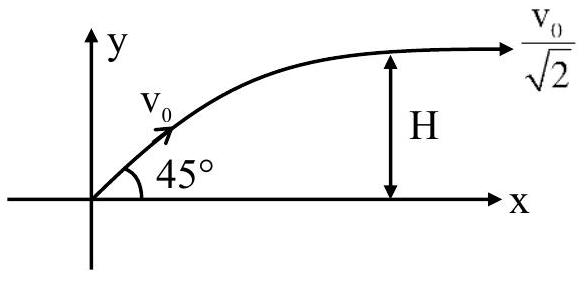
An object of mass 'm' is projected from origin in a vertical xy plane at an angle 45∘ with the x-axis with an initial velocity v0. The magnitude and direction of the angular momentum of the object with respect to origin, when it reaches at the maximum height, will be [g is acceleration due to gravity]
(A)22gmv03 along negative z-axis
(B)22gmv03 along positive z-axis
(C)42gmv03 along positive z-axis
(D)42gmv03 along negative z-axis✓ Correct
Answer: (D)
Solution
The object is launched at 45∘ with speed v0, so vx=v0cos45∘=2v0 and vy=v0sin45∘=2v0.
At maximum height the vertical velocity vanishes and only vx=2v0 survives, directed along the x-axis. The maximum height reached is H=2g(v0sin45∘)2=2gv02/2=4gv02
At this instant the position vector from the origin is r=xi^+Hj^ and the velocity is v=vxi^. The angular momentum is L=m(r×v)=m(xi^+Hj^)×(vxi^)=−mHvxk^
So L points along the negative z-axis, with magnitude L=mHvx=m⋅4gv02⋅2v0=42gmv03
JEE Main · 2025 · 24 Jan 2025 · Shift 1 · Single correct option