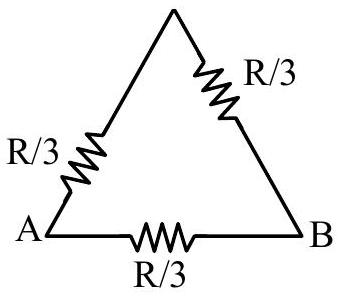
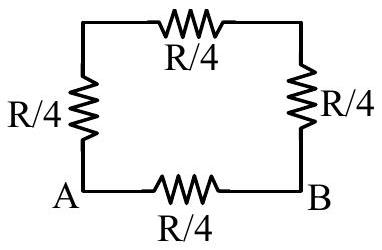
A wire of resistance R is bent into an equilateral triangle and an identical wire is bent into a square. The ratio of resistance between the two end points of an edge of the triangle to that of the square is
(A)9/8
(B)8/9
(C)27/32
(D)32/27✓ Correct
Answer: (D)
Solution
A wire of total resistance R is bent first into an equilateral triangle and then, using an identical wire, into a square; resistance being proportional to length, each side carries a resistance equal to R divided by the number of sides.
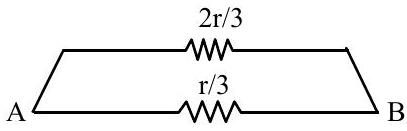
Triangle: each side has resistance R/3. Between the two ends of one edge, that edge (R/3) is in parallel with the other two sides in series (2R/3):
(Req)△=R/3+2R/3(R/3)(2R/3)=92R
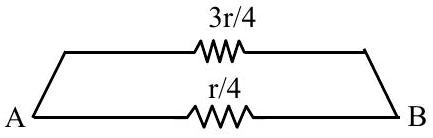
Square: each side has resistance R/4. Between the ends of one edge, that edge (R/4) is in parallel with the remaining three sides in series (3R/4):
(Req)□=R/4+3R/4(R/4)(3R/4)=163R
Ratio:
(Req)□(Req)△=3R/162R/9=2732
JEE Main · 2025 · 28 Jan 2025 · Shift 1 · Single correct option