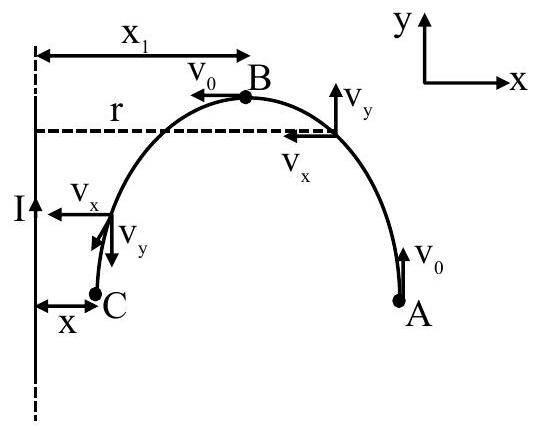
Consider a long thin conducting wire carrying a uniform current I. A particle having mass "M" and charge "q" is released at a distance "a" from the wire with a speed vo along the direction of current in the wire. The particle gets attracted to the wire due to magnetic force. The particle turns round when it is at distance x from the wire. The value of x is [μ0 is vacuum permeability]
(A)a[1−2qμoImvo]
(B)2a
(C)a[1−qμoImvo]
(D)aeqμoI−4πmvo✓ Correct
Answer: (D)
Solution
Take the wire along the z-axis carrying current I, so the field at perpendicular distance r is B=μ0I/(2πr), directed azimuthally. A particle of charge q and mass m moving with velocity v feels F=qv×B; since this force is always perpendicular to v, it does no work, so the particle's speed stays fixed at v0 throughout the motion — only its direction rotates.
Resolving the equations of motion for the component of velocity toward the wire (vx) and along the wire's length (vy) gives, for the phase in which the particle approaches the wire from distance a down to its closest distance x1 (where the velocity has become entirely radial):
v02−vx2vxdvx=−2πmμ0Iqrdr
Integrating from vx=0 at r=a to vx=v0 at r=x1:
v0=2πmμ0Iqlnx1a⟹x1=ae−μ0Iq2πmv0
By the same reasoning, the particle then rebounds and swings back toward the wire under the identical rotational field, so the same relation carries it from x1 in to the final turning point x:
x=x1e−μ0Iq2πmv0
Combining the two legs of the motion,
x=ae−μ0Iq4πmv0
JEE Main · 2025 · 28 Jan 2025 · Shift 1 · Single correct option