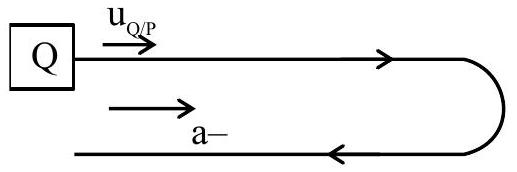
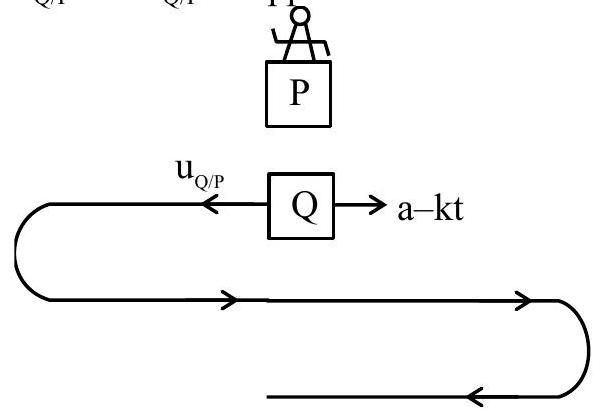
Two cars P and Q are moving on a road in the same direction. Acceleration of car P increases linearly with time whereas car Q moves with a constant acceleration. Both cars cross each other at time t=0, for the first time. The maximum possible number of crossing(s) (including the crossing at t=0 ) is ____ .
Answer: 3
Solution
Let x(t) denote the position of Q relative to P, with x(0)=0 marking the crossing at t=0. Car Q has constant acceleration a and car P has acceleration increasing linearly, aP=kt, so the relative acceleration is
arel(t)=a−kt
The relative velocity is
vrel(t)=u+at−2kt2
where u is the (unspecified) relative velocity at t=0 — a quadratic in t, so it can vanish at no more than 2 values of t.
Integrating again, the relative position is
x(t)=ut+2at2−6kt3
This is a cubic in t with x(0)=0 built in. Dividing out the factor of t leaves a quadratic,
u+2at−6kt2=0
which has at most 2 real roots. So x(t)=0 has at most 3 roots in total — the one at t=0 plus at most 2 more, occurring whenever u and the changing sign of arel(t) make the relative displacement reverse direction twice after the initial crossing.
The maximum possible number of crossings, including the one at t=0, is 3.
JEE Main · 2025 · 29 Jan 2025 · Shift 2 · Integer answer