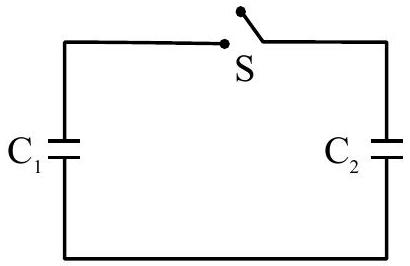
A capacitor, C1=6μF is charged to a potential difference of V0=5V using a 5 V battery. The battery is removed and another capacitor, C2=12μF is inserted in place of the battery. When the switch ' S ' is closed, the charge flows between the capacitors for some time until equilibrium condition is reached. What are the charges ( q1 and q2 ) on the capacitors C1 and C2 when equilibrium condition is reached.Circuit diagram
(A)q1=15μC,q2=30μC
(B)q1=30μC,q2=15μC
(C)q1=10μC,q2=20μC✓ Correct
(D)q1=20μC,q2=10μC
Answer: (C)
Solution
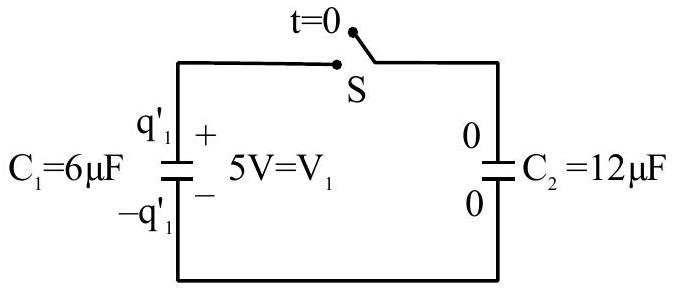
Before the switch is closed, capacitor C1=6μF carries the charge it picked up from the battery:
q1′=C1V0=6×5=30μC
C2=12μF is completely uncharged.
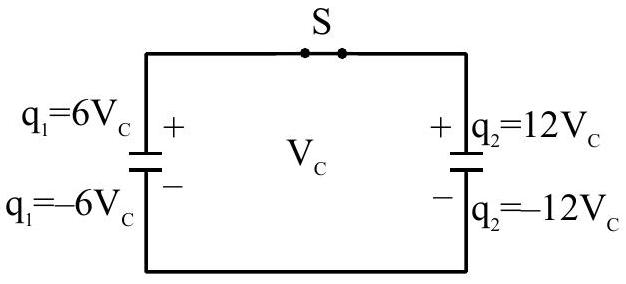
Once the switch closes, the two capacitors are connected in parallel and charge redistributes between them until they reach a common potential V. Charge is conserved through this process:
q1+q2=q1′+q2′=30μC
At the common potential,
q1=C1V=6V,q2=C2V=12V
Substituting into the conservation equation:
6V+12V=30⟹18V=30⟹V=35 V
q1=6×35=10μC,q2=12×35=20μC
Initial stateFinal state
JEE Main · 2025 · 29 Jan 2025 · Shift 2 · Single correct option