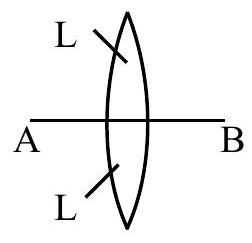
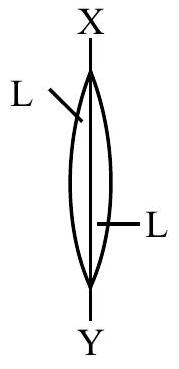
Two identical symmetric double convex lenses of focal length f are cut into two equal parts L1,L2 by AB plane and L3,L4 by XY plane as shown in figure respectively. The ratio of focal lengths of lenses L1 and L3 isLens cutting diagramsAlternative representation of lens cuts
(A)1:4
(B)1:1
(C)2:1
(D)1:2✓ Correct
Answer: (D)
Solution
Cutting the lens along the AB plane (a plane containing the optical axis) splits it into two halves side by side, L1 and L2; each half keeps both of its curved surfaces with their original radii of curvature, only the aperture (diameter) is reduced. Since the lens maker's formula
f1=(μ−1)(R11−R21)
does not involve the aperture, the focal length of each half is unchanged:
fL1=fL2=f
Cutting along the XY plane (perpendicular to the axis) splits the lens into a front piece and a back piece, L3 and L4; each is now a plano-convex lens, keeping only one of the two original curved surfaces (radius R) with the other face flat. For the original symmetric biconvex lens, R1=R, R2=−R, so
f1=(μ−1)(R1+R1)=R2(μ−1)
For the plano-convex half, only one curved surface contributes:
fL31=(μ−1)R1=2f1⟹fL3=2f
So
fL3fL1=2ff=21
JEE Main · 2025 · 29 Jan 2025 · Shift 2 · Single correct option