Given below are two statements. One is labelled as Assertion (A) and the other is labelled as Reason (R).
Assertion (A) : With the increase in the pressure of an ideal gas, the volume falls off more rapidly in an isothermal process in comparison to the adiabatic process.
Reason (R) : In isothermal process, PV = constant, while in adiabatic process PVγ= constant. Here γ is the ratio of specific heats, P is the pressure and V is the volume of the ideal gas.
In the light of the above statements, choose the correct answer from the options given below :
(A)Both (A) and (R) are true but (R) is NOT the correct explanation of (A)
(B)(A) is true but (R) is false
(C)Both (A) and (R) are true and (R) is the correct explanation of (A).✓ Correct
(D)(A) is false but (R) is true
Answer: (C)
Solution
For an isothermal process, PV=constant. Differentiating,
PdV+VdP=0⟹(dVdP)iso=−VP
For an adiabatic process, PVγ=constant. Differentiating,
γPVγ−1dV+VγdP=0⟹(dVdP)adia=−γVP
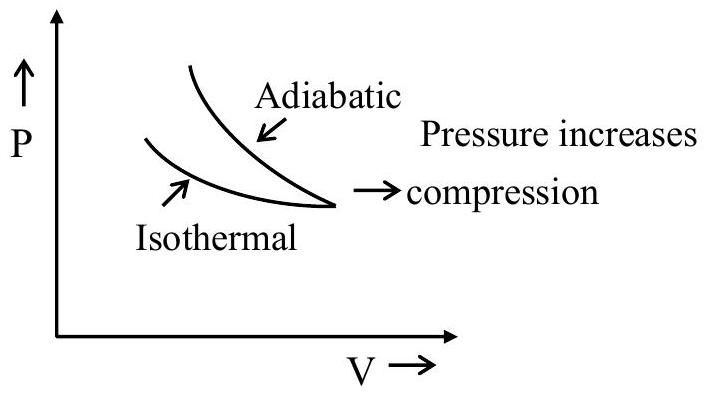
Since γ>1, the adiabatic curve is steeper on a P-V diagram: dVdPadia>dVdPiso.
Looking instead at how volume responds to a small rise in pressure,
(dPdV)iso=−PV,(dPdV)adia=−γPV
so dPdViso>dPdVadia — for the same rise in pressure, the volume falls off more in the isothermal process than in the adiabatic one. This confirms Assertion (A).
Reason (R) states exactly the two governing relations, PV=constant and PVγ=constant, from which this comparison directly follows, so (R) is indeed the correct explanation of (A).
Both (A) and (R) are true, and (R) correctly explains (A).P-V diagram showing isothermal and adiabatic curves
JEE Main · 2025 · 29 Jan 2025 · Shift 2 · Single correct option