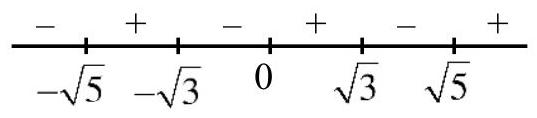
Since ex2>0 always, the sign of f′ is the sign of g(x)=x(x2−3)(x2−5), which has zeros at x=0,±3,±5.
Checking the sign of g in each interval (testing x=−3,−2,−1,1,2,3) gives the pattern −,+,−,+,−,+ across (−∞,−5),(−5,−3),(−3,0),(0,3),(3,5),(5,∞).
A sign change from − to + gives a local minimum, and from + to − a local maximum:
local minima at x=−5,0,5 (3 points)
local maxima at x=−3,3 (2 points)
The numbers of local maximum and local minimum points, respectively, are 2 and 3.
JEE Main · 2025 · 22 Jan 2025 · Shift 2 · Single correct option