Given below are two statements : one is labelled as Assertion (A) and the other is labelled as Reason (R).
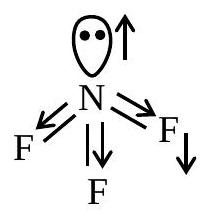
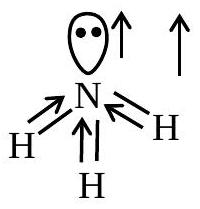
Assertion (A) : NH3 and NF3 molecule have pyramidal shape with a lone pair of electrons on nitrogen atom. The resultant dipole moment of NH3 is greater than that of NF3.
Reason (R): In NH3, the orbital dipole due to lone pair is in the same direction as the resultant dipole moment of the N−H bonds. F is the most electronegative element.
In the light of the above statements, choose the correct answer from the options given below:
(A)Both (A) and (R) are true and (R) is the correct explanation of (A)✓ Correct
(B)(A) is false but (R) is true
(C)(A) is true but (R) is false
(D)Both (A) and (R) are true but (R) is NOT the correct explanation of (A)
Answer: (A)
Solution
In NH3, the lone pair on nitrogen and the resultant of the three N–H bond dipoles both point away from the hydrogens, toward and beyond N, so they reinforce each other, giving a comparatively large net dipole moment (≈1.47 D). In NF3, the highly electronegative fluorine atoms pull electron density (and hence the bond-dipole resultant) toward themselves, i.e. away from N, so the bond-dipole resultant now opposes the lone-pair dipole and partly cancels it, giving a much smaller net moment (≈0.24 D). So the Assertion (net dipole of NH3 greater than NF3) is true, and the Reason correctly identifies why — the lone-pair dipole adds to the bond-dipole resultant in NH3 but opposes it in NF3 because F is strongly electronegative.
JEE Main · 2024 · 05 Apr 2024 · Shift 2 · Single correct option