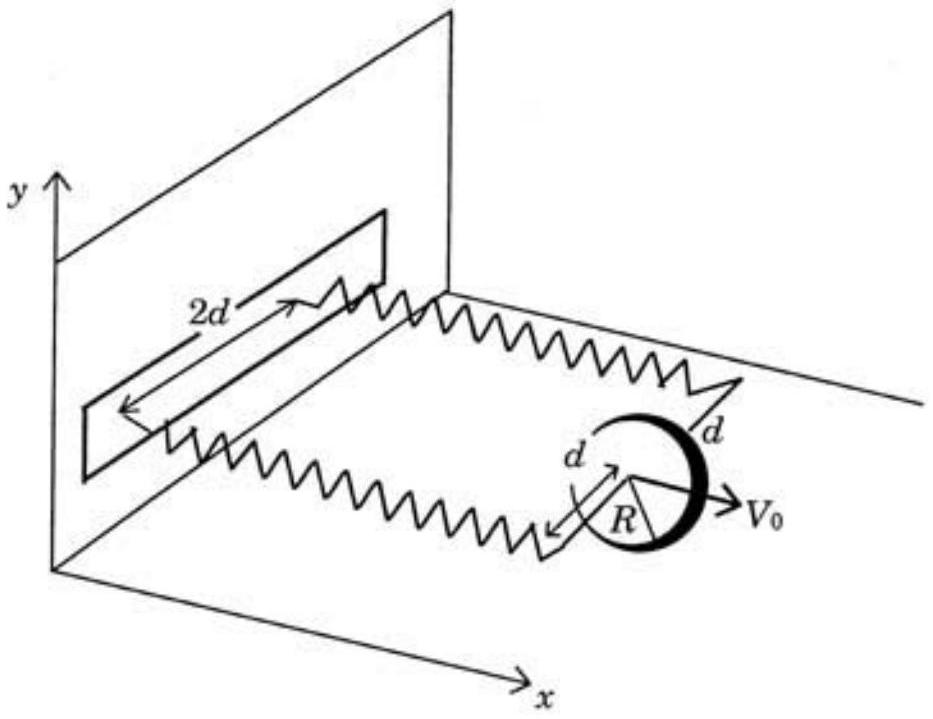
A uniform thin cylindrical disk of mass M and radius R is attached to two identical massless springs of spring constant k which are fixed to the wall as shown in the figure. The springs are attached to the axle of the disk symmetrically on either side at a distance d from its centre. The axle is massless and both the springs and the axle are in a horizontal plane. The unstretched length of each spring is L. The disk is initially at its equilibrium position with its centre of mass (CM) at a distance L from the wall. The disk rolls without slipping with velocity V0=V0i^. The coefficient of friction is μ.
The net external force acting on the disk when its centre of mass is at displacement x with respect to its equilibrium position is
(A)−kx
(B)−2kx
(C)−32kx
(D)−34kx✓ Correct
Answer: (D)
Solution
When the disk is displaced by x, both springs exert a restoring force. The total spring force is Fspring=−2kx.
For rolling without slipping, we have the constraint a=Rα, where a is linear acceleration and α is angular acceleration.
Applying Newton's second law for translation: 2kx−f=Ma
Applying Newton's second law for rotation about the center: fR=Iα=21MR2⋅Ra=21MRa
From the rotational equation: f=2Ma
Substituting into the translational equation:
2kx−2Ma=Ma
2kx=23Ma
Ma=34kx
Therefore, the net external force is Fnet=Ma=−34kx (negative for restoring force).
JEE Advanced · 2008 · 13 Apr 2008 · Paper 2 · Single correct option