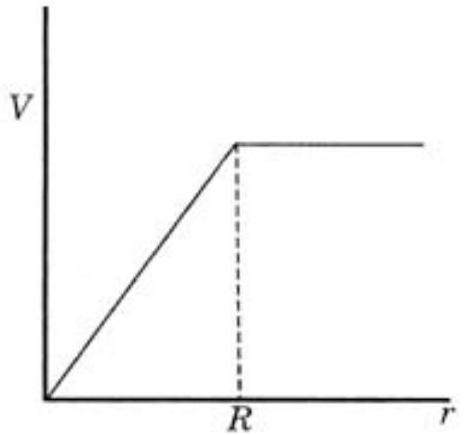
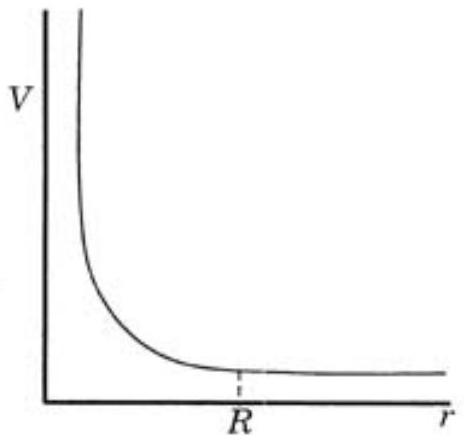
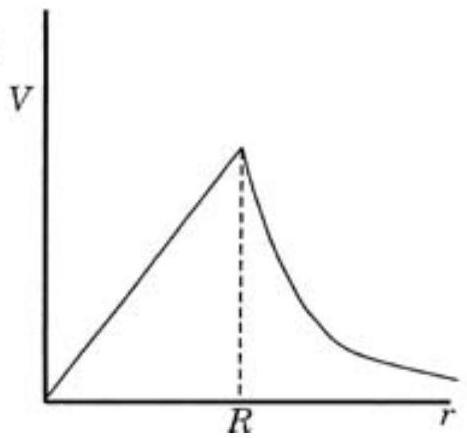
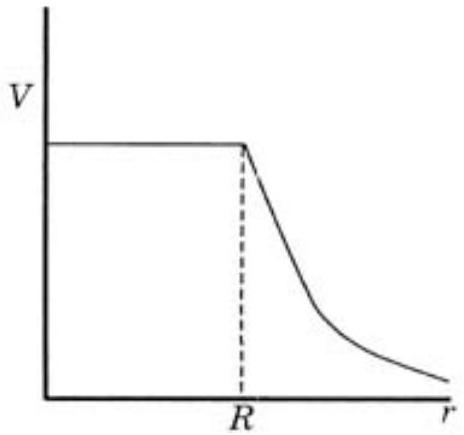
A spherically symmetric gravitational system of particles has a mass density ρ={ρ00 for r≤R for r>R where ρ0 is a constant. A test mass can undergo circular motion under the influence of the gravitational field of particles. Its speed V as a function of distance r(0<r<∞) from the centre of the system is represented by
(A)(see structure)
(B)(see structure)
(C)(see structure)✓ Correct
(D)(see structure)
Answer: (C)
Solution
For r≤R, the gravitational force on a test mass at distance r is due to the mass enclosed within radius r: M(r)=34πr3ρ0. For circular motion, r2GM(r)=rv2, giving v2=34πGρ0r2, so v∝r. For r>R, the total mass is constant: M=34πR3ρ0. Thus r2GM=rv2, giving v2=rGM, so v∝r1. Graph (C) shows this behavior.
JEE Advanced · 2008 · 13 Apr 2008 · Paper 1 · Single correct option