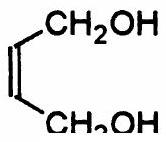
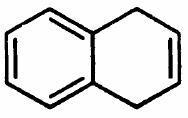
P and Q are isomers of dicarboxylic acid C4H4O4. Both decolorize Br2/H2O. On heating, P forms the cyclic anhydride. Upon treatment with dilute alkaline KMnO4, P as well as Q could produce one or more than one from S,T and U.
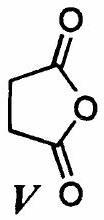
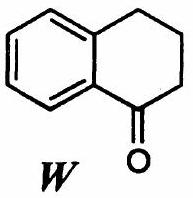
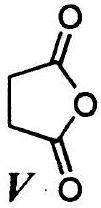
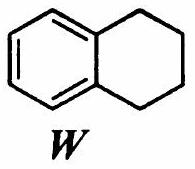
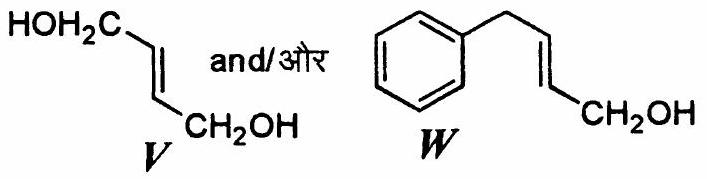
In the following reaction sequences V and W are, respectively
QH2/NiΔV
(A)(see structure)VW✓ Correct
(B)(see structure)VW
(C)(see structure)VW
(D)(see structure)
Answer: (A)
Solution
Q is fumaric acid (trans-butenedioic acid). Hydrogenation with H2/Ni reduces the double bond to give succinic acid. Heating succinic acid forms succinic anhydride (V).
Further heating/decarboxylation can lead to cyclic products. The reaction sequence produces the cyclic anhydride and a cyclic ketone (W).
JEE Advanced · 2013 · 02 Jun 2013 · Paper 2 · Single correct option