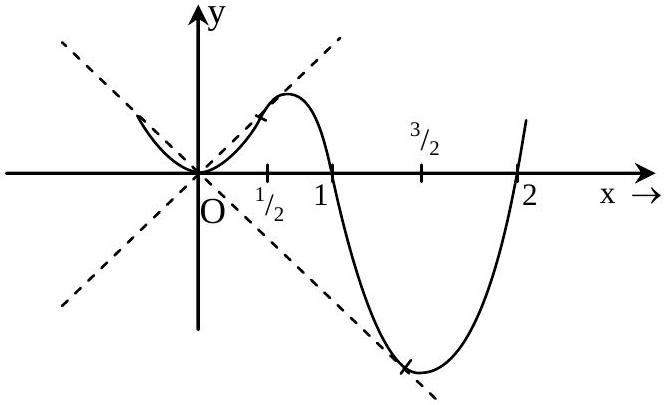
Let f(x)=xsinπx,x>0. Then for all natural numbers n,f′(x) vanishes at
(A)a unique point in the interval (n,n+21)
(B)a unique point in the interval (n+21,n+1)✓ Correct
(C)a unique point in the interval (n,n+1)✓ Correct
(D)two points in the interval (n,n+1)
Answer: (B), (C)
Solution
We have f′(x)=sin(πx)+πxcos(πx). At x=n, f′(n)=0+πncos(nπ)=πn(−1)n, which is non-zero. At x=n+21, f′(n+21)=sin(π(n+21))+0=±1, which is non-zero. At x=n+1, f′(n+1)=0+π(n+1)(−1)n+1, which is non-zero. Since f′ is continuous and changes sign between n+21 and n+1, there is exactly one zero in (n+21,n+1) by the Intermediate Value Theorem. This is also the unique zero in (n,n+1). Thus options B and C are correct.
JEE Advanced · 2013 · 02 Jun 2013 · Paper 1 · One or more correct options