JEE Advanced · 2013 · 02 Jun 2013 · Paper 1 · Chemical Kinetics

WhatsApp Email
In the reaction,

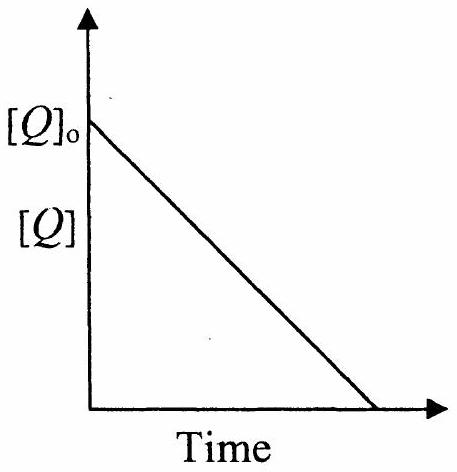
the time taken for 75% reaction of is twice the time taken for 50% reaction of . The concentration of varies with reaction time as shown in the figure. The overall order of the reaction is
  1. (A)2
  2. (B)3
  3. (C)0
  4. (D)1✓ Correct

Answer: (D)

Solution

For reactant P: For a first-order reaction, (since ). This confirms P follows first-order kinetics.

For reactant Q: The graph shows concentration of Q decreasing linearly with time, which is characteristic of zero-order kinetics.

Overall order = order w.r.t. P + order w.r.t. Q = 1 + 0 = 1

JEE Advanced · 2013 · 02 Jun 2013 · Paper 1 · Single correct option
More JEE Advanced questions on Chemical Kinetics

  1. For a reversible reaction , at constant temperature, both the forward and the backward reactions are first order elementary reactions with rate constant and , respectively. At time zero, the concentration of …
    JEE Advanced 2026View solution →
  2. For a first-order reaction at a given temperature, is the rate constant. For this reaction, at the given temperature, the concentrations of and at a time are and , respectively. The …
    JEE Advanced 2026View solution →
  3. Consider a reaction Product. The rate of this reaction is measured to be . At the start of the reaction, the concentration of , is 10-times the concentration of . The reaction can be considered to be a pseudo first order reaction w …
    JEE Advanced 2025View solution →
  4. Consider the following reaction,

    which follows the mechanism given below: …
    JEE Advanced 2024View solution →
  5. A sample initially contains only U-238 isotope of uranium. With time, some of the U-238 radioactively decays into Pb-206 while the rest of it remains undisintegrated.
    When the age of the sample is years, the ratio of mass of to tha …
    JEE Advanced 2024View solution →
  6. The plot of versus for a reversible reaction is shown.

    (see plot)

    Pre-exponential factors for the forward and backward reactions are …
    JEE Advanced 2023View solution →