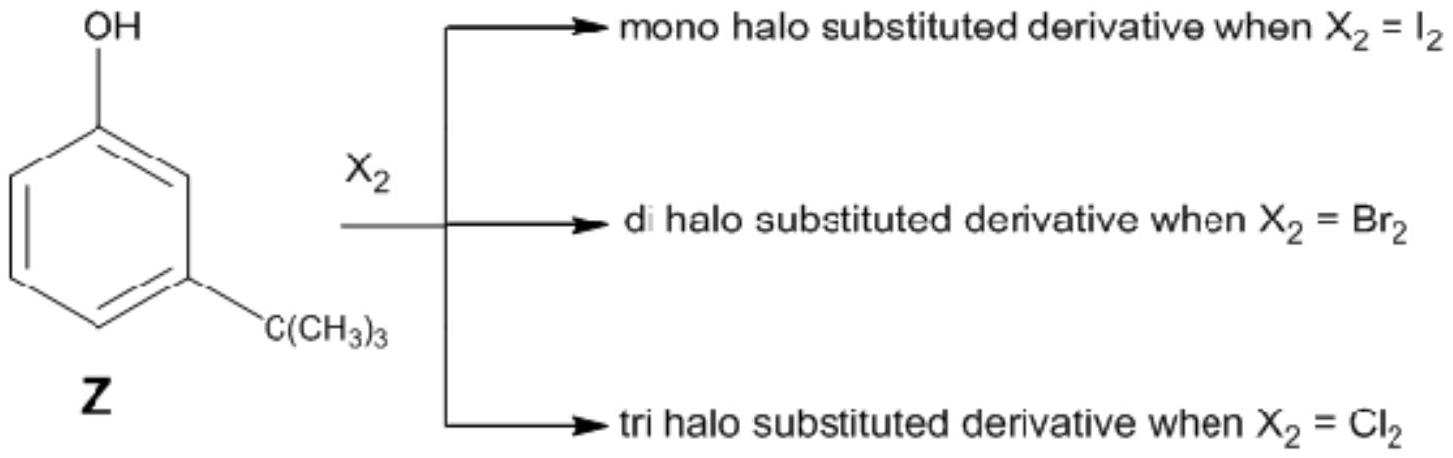
The reactivity of compound Z with different halogens under appropriate conditions is given below:
The observed pattern of electrophilic substitution can be explained by
(A)the steric effect of the halogen✓ Correct
(B)the steric effect of the tert-butyl group✓ Correct
(C)the electronic effect of the phenolic group✓ Correct
(D)the electronic effect of the tert-butyl group
Answer: (A), (B), (C)
Solution
The compound Z is a phenol with a bulky tert-butyl group at the para position. In electrophilic aromatic substitution:
• The phenolic OH group is a strong ortho-para director due to its +R (electron-donating resonance) effect, activating the ring. • The tert-butyl group is bulky and blocks the para position sterically. • Smaller halogens (Cl, Br) can attack the ortho position despite some steric hindrance from the tert-butyl group. • Larger halogens (I) face greater steric hindrance from both the tert-butyl group and the halogen's own size, affecting the substitution pattern.
Thus, the pattern is explained by: (A) steric effect of the halogen, (B) steric effect of the tert-butyl group, and (C) electronic effect of the phenolic group (activation and directing). The tert-butyl group's electronic effect is minimal (weak +I), so (D) is not a major factor.
JEE Advanced · 2014 · 25 May 2014 · Paper 1 · One or more correct options