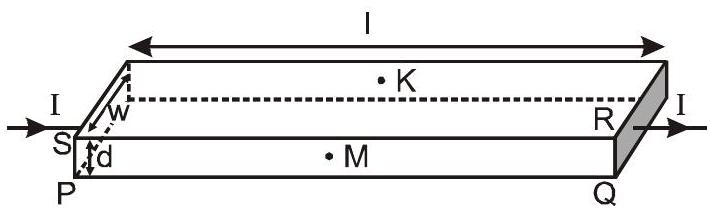
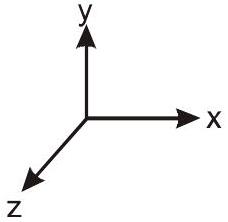
In a thin rectangular metallic strip a constant current I flows along the positive x-direction, as shown in the figure. The length, width and thickness of the strip are l, w and d, respectively.
A uniform magnetic field B is applied on the strip along the positive y-direction. Due to this, the charge carriers experience a net deflection along the z-direction. This results in accumulation of charge carriers on the surface PQRS and appearance of equal and opposite charges on the face opposite to PQRS. A potential difference along the z-direction is thus developed. Charge accumulation continues until the magnetic force is balanced by the electric force. The current is assumed to be uniformly distributed on the cross section of the strip and carried by electrons.
Consider two different metallic strips (1 and 2) of same dimensions (length l, width w and thickness d) with carrier densities n1 and n2, respectively. Strip 1 is placed in magnetic field B1 and strip 2 is placed in magnetic field B2, both along positive y-directions. Then V1 and V2 are the potential differences developed between K and M in strips 1 and 2, respectively. Assuming that the current I is the same for both the strips, the correct option(s) is(are)
(A)If B1=B2 and n1=2n2, then V2=2V1✓ Correct
(B)If B1=B2 and n1=2n2, then V2=V1
(C)If B1=2B2 and n1=n2, then V2=0.5V1✓ Correct
(D)If B1=2B2 and n1=n2, then V2=V1
Answer: (A), (C)
Solution
From the Hall effect analysis in Q17, the Hall voltage is:
V=nedIB
For strips with same dimensions but different carrier densities and magnetic fields:
V1=n1edIB1 and V2=n2edIB2
Therefore: V1V2=B1B2⋅n2n1
(A) If B1=B2 and n1=2n2: V1V2=1⋅n22n2=2, so V2=2V1 ✓
(B) Same conditions give V2=2V1, not V2=V1 ✗
(C) If B1=2B2 and n1=n2: V1V2=2B2B2⋅1=0.5, so V2=0.5V1 ✓
(D) Same conditions give V2=0.5V1, not V2=V1 ✗
JEE Advanced · 2015 · 24 May 2015 · Paper 2 · One or more correct options