JEE Advanced · 2015 · 24 May 2015 · Paper 1 · Equilibrium

WhatsApp Email
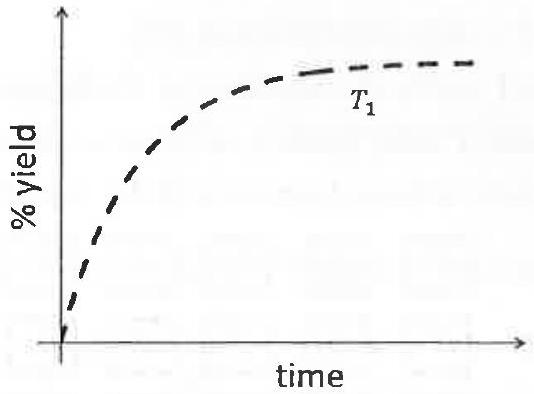
The %yield of ammonia as a function of time in the reaction

at is given below.
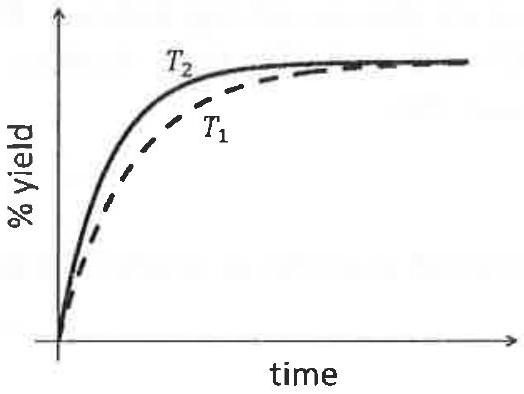
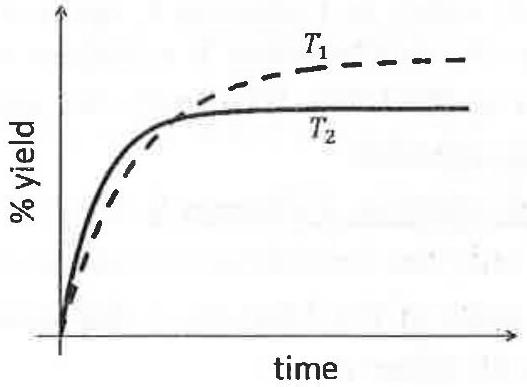
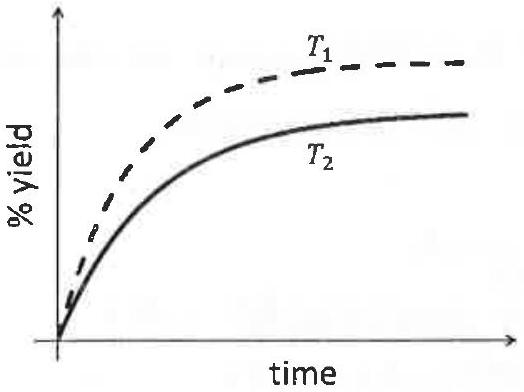
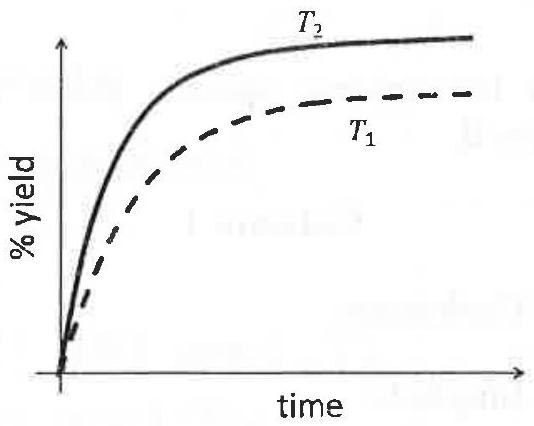
If this reaction is conducted at , with , the %yield of ammonia as a function of time is represented by
  1. (A)(see structure)
  2. (B)(see structure)
    ✓ Correct
  3. (C)(see structure)
  4. (D)(see structure)

Answer: (B)

Solution

The reaction is exothermic (). According to Le Chatelier's principle:
  • At higher temperature (), the equilibrium shifts backward (favoring reactants), so the equilibrium yield decreases.
  • However, the rate of reaction increases at higher temperature, so equilibrium is reached faster.

Therefore, the curve should reach a lower equilibrium yield but in less time. This is represented by graph (B).

JEE Advanced · 2015 · 24 May 2015 · Paper 1 · One or more correct options
More JEE Advanced questions on Equilibrium

  1. At 25°C, the concentration of ions in aqueous solution of a weak monobasic acid having acid dissociation constant is . The value of …
    JEE Advanced 2025View solution →
  2. The solubility of barium iodate in an aqueous solution prepared by mixing 200 mL of 0.010 M barium nitrate with 100 mL of 0.10 M sodium iodate is . The value of is ____.

    Use: Solubility product consta …
    JEE Advanced 2025View solution →
  3. On decreasing the from 7 to 2, the solubility of a sparingly soluble salt (MX) of a weak acid (HX) increased from to . The of HX is:
    JEE Advanced 2023View solution →
  4. A solution is prepared by mixing 0.01 mol each of , and NaOH in 100 mL of water. pH of the resulting solution is ____.
    [Given : and …
    JEE Advanced 2022View solution →
  5. Concentration of and in a solution is 1 M and , respectively. Molar solubility of in the same solution is …
    JEE Advanced 2022View solution →
  6. A solution of 0.1 M weak base (B) is titrated with 0.1 M of a strong acid (HA). The variation of pH of the solution with the volume of HA added is shown in the figure below. What is the of the base? The neutralization reaction is given by …
    JEE Advanced 2020View solution →