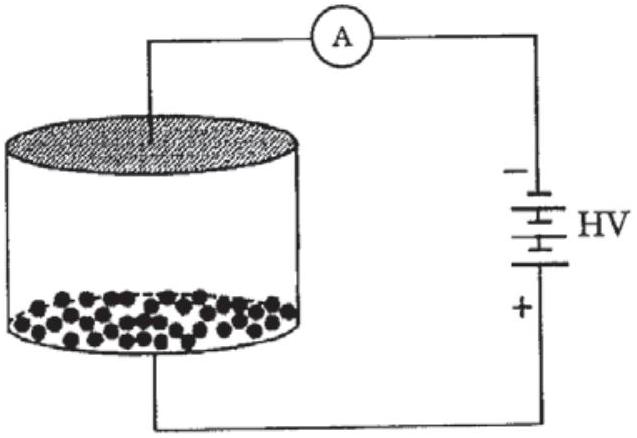
Consider an evacuated cylindrical chamber of height h having rigid conducting plates at the ends and an insulating curved surface as shown in the figure. A number of spherical balls made of a light weight and soft material and coated with a conducting material are placed on the bottom plate. The balls have a radius r≪h. Now a high voltage source (HV) is connected across the conducting plates such that the bottom plate is at +V0 and the top plate at −V0. Due to their conducting surface, the balls will get charged, will become equipotential with the plate and are repelled by it. The balls will eventually collide with the top plate, where the coefficient of restitution can be taken to be zero due to the soft nature of the material of the balls. The electric field in the chamber can be considered to be that of a parallel plate capacitor. Assume that there are no collisions between the balls and the interaction between them is negligible. (Ignore gravity)
PARAGRAPH 2
Consider an evacuated cylindrical chamber of height h having rigid conducting plates at the ends and an insulating curved surface as shown in the figure. A number of spherical balls made of a light weight and soft material and coated with a conducting material are placed on the bottom plate. The balls have a radius r≪h. Now a high voltage source (HV) is connected across the conducting plates such that the bottom plate is at +V0 and the top plate at −V0. Due to their conducting surface, the balls will get charged, will become equipotential with the plate and are repelled by it. The balls will eventually collide with the top plate, where the coefficient of restitution can be taken to be zero due to the soft nature of the material of the balls. The electric field in the chamber can be considered to be that of a parallel plate capacitor. Assume that there are no collisions between the balls and the interaction between them is negligible. (Ignore gravity)
Which one of the following statements is correct?
(A)The balls will stick to the top plate and remain there
(B)The balls will bounce back to the bottom plate carrying the same charge they went up with
(C)The balls will bounce back to the bottom plate carrying the opposite charge they went up with✓ Correct
(D)The balls will execute simple harmonic motion between the two plates
Answer: (C)
Solution
Initially, the balls acquire positive charge from the bottom plate and are repelled upward.
When they reach the top plate (at −V0), they undergo inelastic collision (coefficient of restitution = 0) and become equipotential with the top plate, acquiring negative charge.
Now negatively charged, they are attracted back to the positive bottom plate.
This process repeats, with the balls alternating charge sign at each plate. The motion is periodic but not SHM (the force is constant in each direction, not proportional to displacement).
JEE Advanced · 2016 · 22 May 2016 · Paper 2 · Single correct option