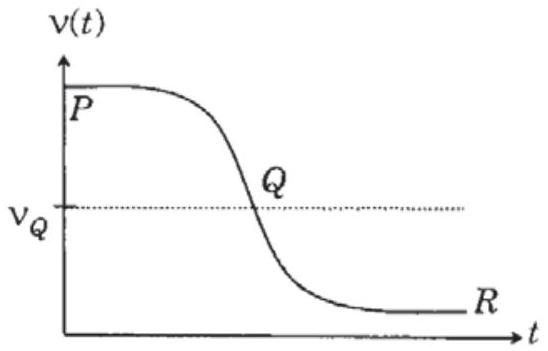
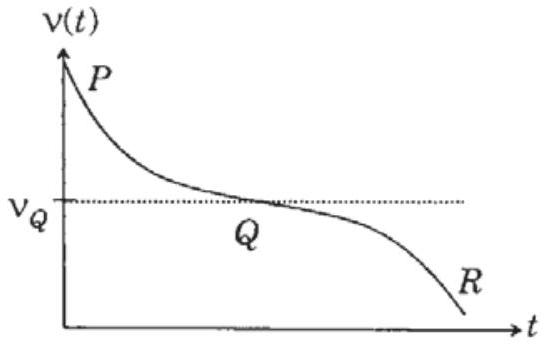
Two loudspeakers M and N are located 20 m apart and emit sound at frequencies 118 Hz and 121 Hz, respectively. A car is initially at a point P, 1800 m away from the midpoint Q of the line MN and moves towards Q constantly at 60 km/hr along the perpendicular bisector of MN. It crosses Q and eventually reaches a point R, 1800 m away from Q. Let v(t) represent the beat frequency measured by a person sitting in the car at time t. Let vP, vQ and vR be the beat frequencies measured at locations P, Q and R, respectively. The speed of sound in air is 330 m s−1. Which of the following statement(s) is(are) true regarding the sound heard by the person? (A) vP+vR=2vQ (B) The rate of change in beat frequency is maximum when the car passes through Q (C) The plot below represents schematically the variation of beat frequency with time (D) The plot below represents schematically the variation of beat frequency with time
(A)vP+vR=2vQ✓ Correct
(B)The rate of change in beat frequency is maximum when the car passes through Q✓ Correct
(C)(see structure)✓ Correct
(D)(see structure)
Answer: (A), (B), (C)
Solution
Due to the Doppler effect, the observed frequencies from M and N change as the car moves. At position P or R, the component of velocity toward each speaker is vDcosα, where α is the angle from the perpendicular bisector.
At P:vP=(121−118)(vv+vDcosα)=3(vv+vDcosα) Hz
At Q:vQ=121−118=3 Hz (no Doppler shift perpendicular to motion)
At R:vR=3(vv−vDcosα) Hz
Therefore vP+vR=2vQ. (A) is correct.
The rate of change dθdv∝−sinθ, which is maximum at Q where θ=90°. (B) is correct.
The beat frequency increases from P to Q and then decreases symmetrically to R, matching graph (C). (C) is correct.
JEE Advanced · 2016 · 22 May 2016 · Paper 1 · One or more correct options