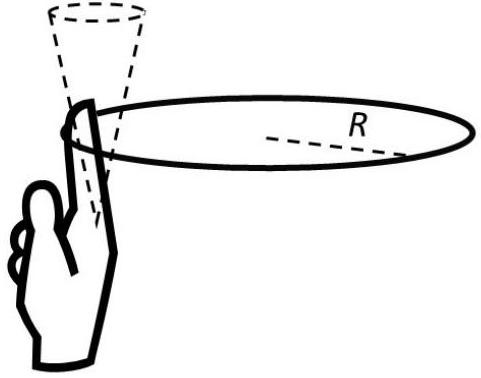
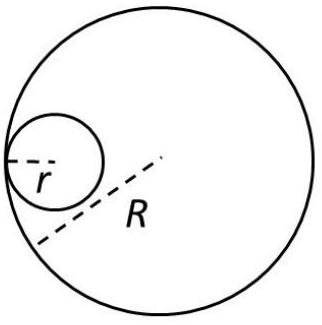
One twirls a circular ring (of mass M and radius R) near the tip of one's finger as shown in Figure 1. In the process the finger never loses contact with the inner rim of the ring. The finger traces out the surface of a cone, shown by the dotted line. The radius of the path traced out by the point where the ring and the finger is in contact is r. The finger rotates with an angular velocity ω0. The rotating ring rolls without slipping on the outside of a smaller circle described by the point where the ring and the finger is in contact (Figure 2). The coefficient of friction between the ring and the finger is μ and the acceleration due to gravity is g.
One twirls a circular ring (of mass M and radius R) near the tip of one's finger as shown in Figure 1. In the process the finger never loses contact with the inner rim of the ring. The finger traces out the surface of a cone, shown by the dotted line. The radius of the path traced out by the point where the ring and the finger is in contact is r. The finger rotates with an angular velocity ω0. The rotating ring rolls without slipping on the outside of a smaller circle described by the point where the ring and the finger is in contact (Figure 2). The coefficient of friction between the ring and the finger is μ and the acceleration due to gravity is g.
The minimum value of ω0 below which the ring will drop down isFigure 1Figure 2
(A)μ(R−r)g✓ Correct
(B)μ(R−r)2g
(C)2μ(R−r)3g
(D)2μ(R−r)g
Answer: (A)
Solution
For the ring not to drop, the friction force must provide the necessary centripetal force and support against gravity. The centripetal acceleration of the center of mass is ω02(R−r). Balancing forces: μN≥Mω02(R−r) and N≥Mg. At the minimum ω0, μMg=Mω02(R−r), giving ω0=μ(R−r)g.
JEE Advanced · 2017 · 21 May 2017 · Paper 2 · Single correct option