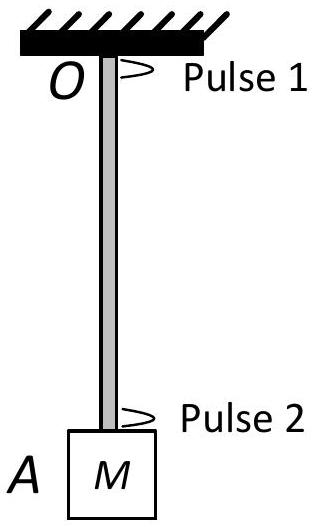
A block M hangs vertically at the bottom end of a uniform rope of constant mass per unit length. The top end of the rope is attached to a fixed rigid support at O. A transverse wave pulse (Pulse 1) of wavelength λ0 is produced at point O on the rope. The pulse takes time TOA to reach point A. If the wave pulse of wavelength λ0 is produced at point A (Pulse 2) without disturbing the position of M it takes time TAO to reach point O. Which of the following options is/are correct?
(A)The time TAO=TOA✓ Correct
(B)The velocities of the two pulses (Pulse 1 and Pulse 2) are the same at the midpoint of rope
(C)The wavelength of Pulse 1 becomes longer when it reaches point A
(D)The velocity of any pulse along the rope is independent of its frequency and wavelength✓ Correct
Answer: (A), (D)
Solution
The speed of a transverse wave on a rope is v=μT, where T is the tension and μ is the linear mass density. The tension varies along the rope due to the weight of the rope below. At any point, the speed depends only on the local tension, not on the frequency or wavelength of the pulse, confirming option (D). Since the tension profile is the same for both pulses (one traveling down, one traveling up), and they traverse the same path through the same tension distribution, the time taken is the same: TAO=TOA, confirming option (A). The wavelength changes as the wave speed changes (since frequency is constant), becoming shorter as the pulse moves down (where tension decreases), making option (C) incorrect.
JEE Advanced · 2017 · 21 May 2017 · Paper 1 · One or more correct options