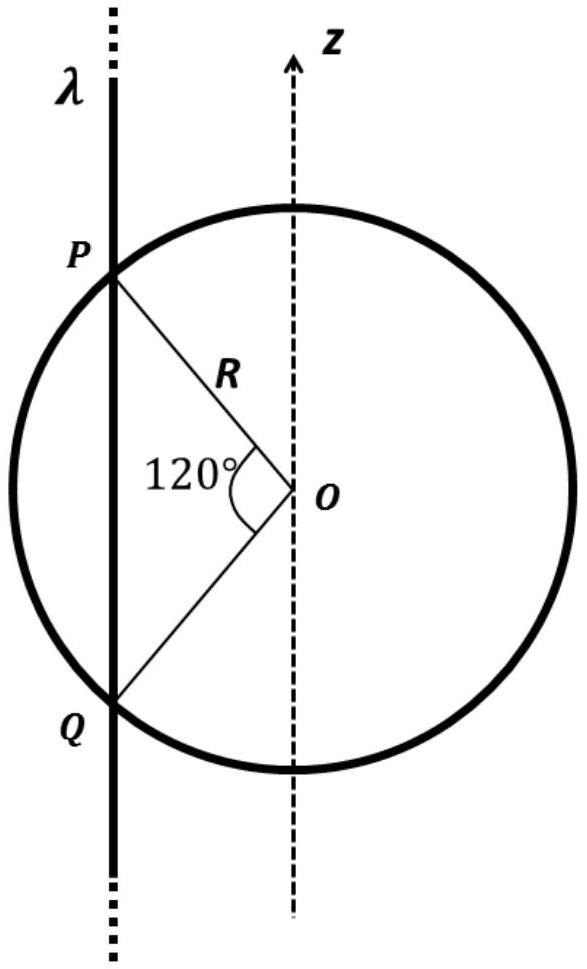
An infinitely long thin non-conducting wire is parallel to the z-axis and carries a uniform line charge density λ. It pierces a thin non-conducting spherical shell of radius R in such a way that the arc PQ subtends an angle 120∘ at the centre O of the spherical shell, as shown in the figure. The permittivity of free space is ϵ0. Which of the following statements is (are) true?
(A)The electric flux through the shell is 3Rλ/ϵ0✓ Correct
(B)The z-component of the electric field is zero at all the points on the surface of the shell✓ Correct
(C)The electric flux through the shell is 2Rλ/ϵ0
(D)The electric field is normal to the surface of the shell at all points
Answer: (A), (B)
Solution
The charge enclosed by the spherical shell is the charge on the wire segment inside it. The length of this segment is 2Rcos30∘=2R⋅23=3R. Therefore, the enclosed charge is q=λ⋅3R. By Gauss's law, the electric flux is Φ=ϵ0q=ϵ03Rλ (A is correct, C is incorrect). The electric field from an infinite line charge is radial (perpendicular to the wire), so it has no component along the z-axis (B is correct). The field is not normal to the spherical surface at all points (D is incorrect).
JEE Advanced · 2018 · 20 May 2018 · Paper 2 · One or more correct options