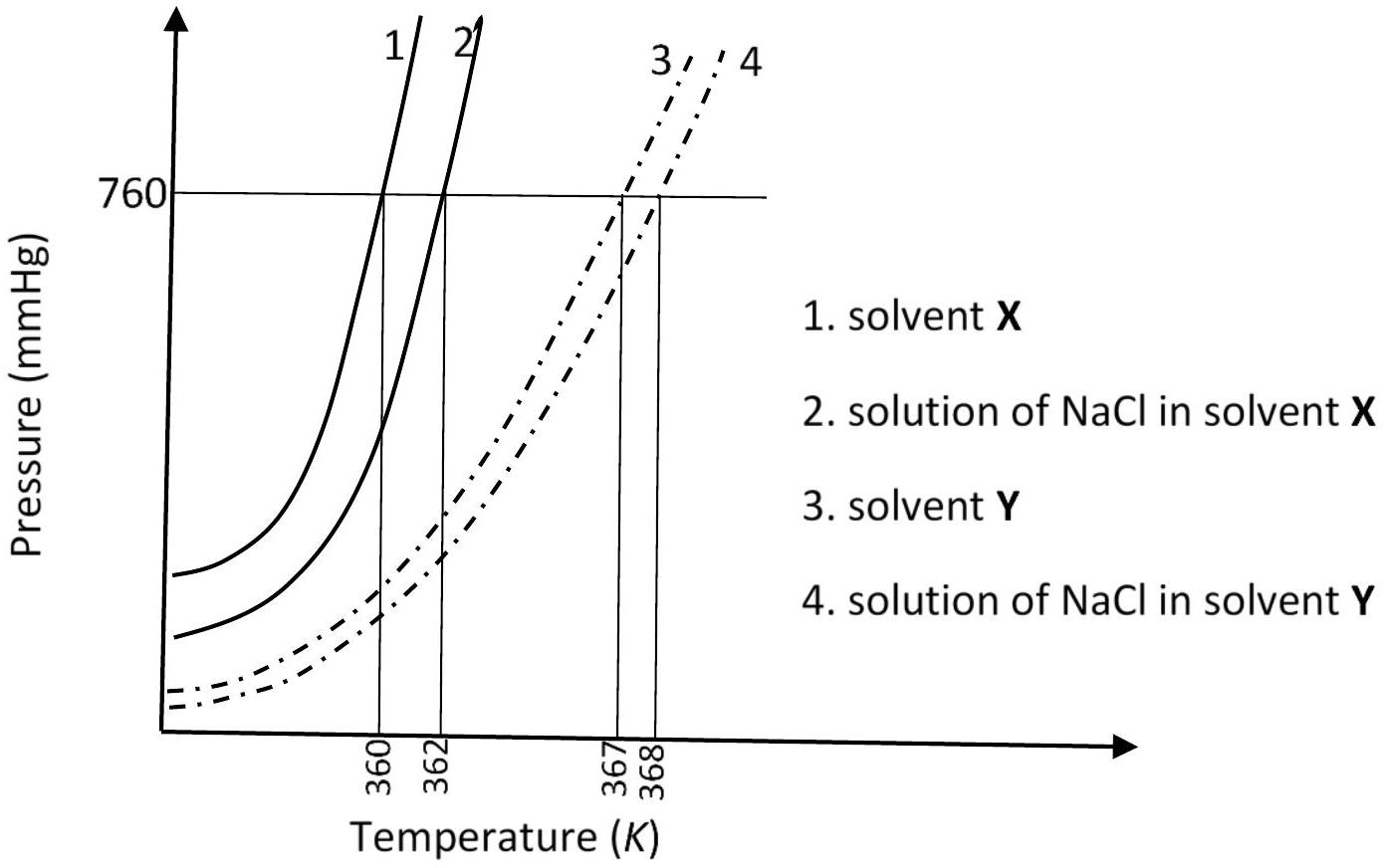
The plot given below shows P−T curves (where P is the pressure and T is the temperature) for two solvents X and Y and isomolal solutions of NaCl in these solvents. NaCl completely dissociates in both the solvents.
On addition of equal number of moles of a non-volatile solute S in equal amount (in kg) of these solvents, the elevation of boiling point of solvent X is three times that of solvent Y. Solute S is known to undergo dimerization in these solvents. If the degree of dimerization is 0.7 in solvent Y, the degree of dimerization in solvent X is ____.
Answer: 0.05
Solution
From the P-T curves, the elevation in boiling point for NaCl solutions:
For solvent X: ΔTb=2 K
For solvent Y: ΔTb=1 K
Since NaCl dissociates completely (i=2) and the solutions are isomolal:
kb(Y)kb(X)=12=2
For dimerization: 2S⇌S2
Van't Hoff factor: i=1−2α
For solvent Y with α=0.7:
iY=1−20.7=0.65
Given that ΔTb(X)=3×ΔTb(Y):
kb(X)⋅m⋅iX=3×kb(Y)⋅m⋅iY
kb(Y)kb(X)⋅iX=3×iY
2⋅iX=3×0.65
iX=21.95=0.975
For solvent X:
0.975=1−2αX
2αX=0.025
αX=0.05
Answer: 0.05
JEE Advanced · 2018 · 20 May 2018 · Paper 1 · Numerical answer