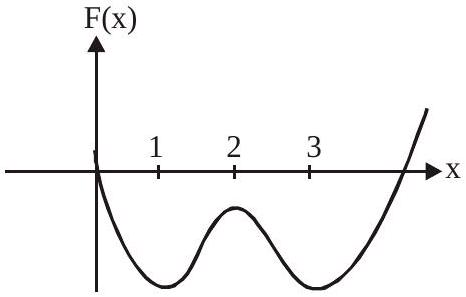
Let f:R→R be given by f(x)=(x−1)(x−2)(x−5). Define F(x)=∫0xf(t)dt,x>0. Then which of the following options is/are correct ?
(A)F has a local minimum at x=1✓ Correct
(B)F has a local maximum at x=2✓ Correct
(C)F(x)=0 for all x∈(0,5)✓ Correct
(D)F has two local maxima and one local minimum in (0,∞)
Answer: (A), (B), (C)
Solution
Given f(x)=(x−1)(x−2)(x−5), we have F′(x)=f(x)=(x−1)(x−2)(x−5) for x>0. The critical points are at x=1,2,5. By analyzing the sign of F′(x), we see that F(x) has local minima at x=1 and x=5, and a local maximum at x=2. Expanding f(x)=x3−8x2+17x−10 and integrating: F(x)=4x4−38x3+217x2−10x. From the graph of y=F(x), we can verify that F(x)=0 for all x∈(0,5). Therefore, options (A), (B), and (C) are correct.
JEE Advanced · 2019 · 27 May 2019 · Paper 2 · One or more correct options