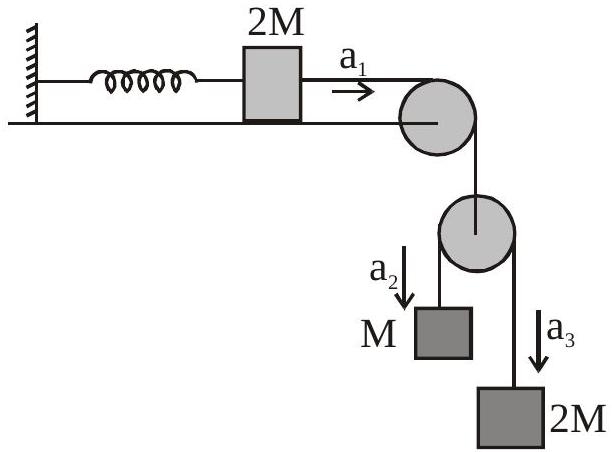
A block of mass 2M is attached to a massless spring with spring-constant k . This block is connected to two other blocks of masses M and 2M using two massless pulleys and strings. The accelerations of the blocks are a1, a2 and a3 as shown in figure. The system is released from rest with the spring in its unstretched state. The maximum extension of the spring is x0. Which of the following option(s) is/are correct ? [g is the acceleration due to gravity. Neglect friction]
(A)x0=k4Mg
(B)When spring achieves an extension of 2x0 for the first time, the speed of the block connected to the spring is 3g5kM
(C)a2−a1=a1−a3✓ Correct
(D)At an extension of 4x0 of the spring, the magnitude of acceleration of the block connected to the spring is 103g
Answer: (C)
Solution
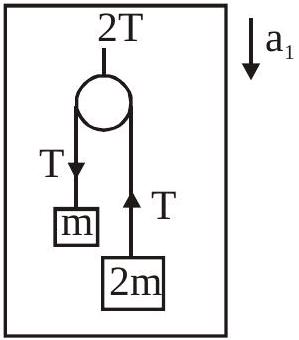
From constraint relations: 2a1=a2+a3, which gives a2−a1=a1−a3. Option (C) is correct.
Analyzing forces on the 2M block:
38Mg−kx=2Ma1
This can be rewritten as:
a1=−14M3k[x−3k8Mg]
This is SHM about x1=3k8Mg with ω=14M3k.
Maximum extension: x0=2x1=3k16Mg, not k4Mg. Option (A) is incorrect.
At x=x0/2, the block passes through mean position with speed:
v0=Aω=3k8Mg⋅14M3k=21k62Mg2
This doesn't match option (B), which is incorrect.
At x=x0/4:
a1=14M8Mg−3k(x0/4)=72g
This is not 103g. Option (D) is incorrect.
JEE Advanced · 2019 · 27 May 2019 · Paper 2 · One or more correct options