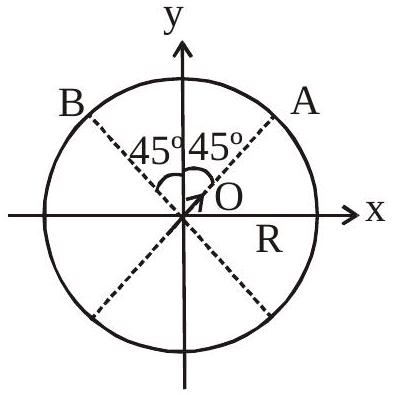
An electric dipole with dipole moment 2p0(i^+j^) is held fixed at the origin O in the presence of an uniform electric field of magnitude E0. If the potential is constant on a circle of radius R centered at the origin as shown in figure, then the correct statement(s) is/are: ( ε0 is permittivity of free space, R≫ dipole size)
(A)R=(4πε0E0p0)1/3✓ Correct
(B)The magnitude of total electric field on any two points of the circle will be same
(C)Total electric field at point A is EA=2E0(i^+j^)
(D)Total electric field at point B is EB=0✓ Correct
Answer: (A), (D)
Solution
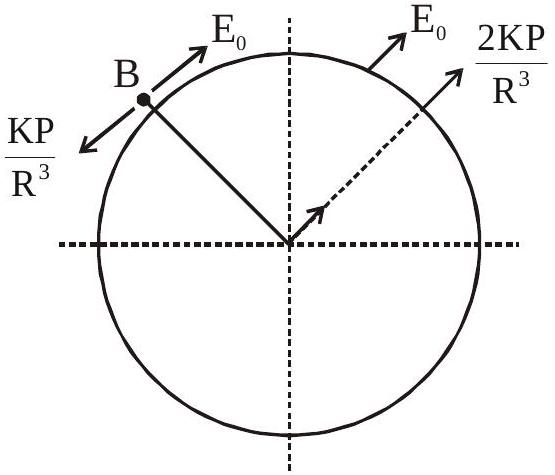
For the circle to be an equipotential, the tangential component of the electric field at point B must be zero. The dipole field at B along the tangent equals E0, so:
E0=R3K∣P∣=R3Kp0
Solving: R3=4πϵ0E0p0, giving R=(4πϵ0E0p0)1/3. Option (A) is correct.
At point B, the uniform field and dipole field cancel tangentially, and the radial components also cancel, so EB=0. Option (D) is correct.
Since E0 is uniform but the dipole field varies at different points, the total field magnitude varies around the circle. Option (B) is incorrect.
At point A, the field is EA=R32KP+R3KP=3E0 along the dipole direction, not 2E0(i^+j^). Option (C) is incorrect.
JEE Advanced · 2019 · 27 May 2019 · Paper 2 · One or more correct options