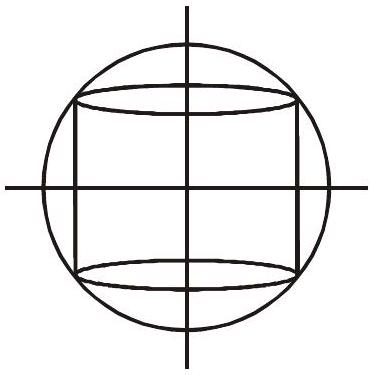
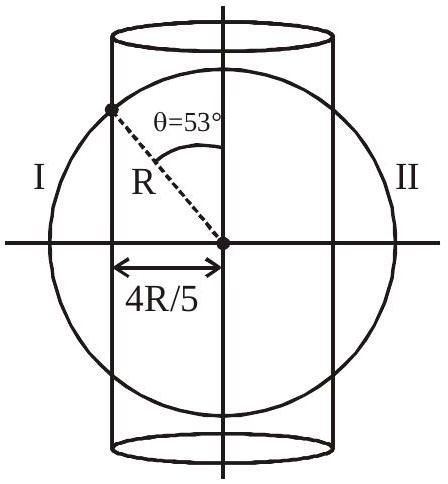
A charged shell of radius R carries a total charge Q. Given Φ as the flux of electric field through a closed cylindrical surface of height h, radius r and with its center same as that of the shell. Here, center of the cylinder is a point on the axis of the cylinder which is equidistant from its top and bottom surfaces. Which of the following option(s) is/are correct ? [ϵ0 is the permittivity of free space]
(A)If h>2R and r>R then Φ=ϵ0Q✓ Correct
(B)If h<58R and r=53R then Φ=0✓ Correct
(C)If h>2R and r=54R then Φ=5ϵ0Q
(D)If h>2R and r=53R then Φ=5ϵ0Q✓ Correct
Answer: (A), (B), (D)
Solution
The flux through the closed cylinder equals the enclosed charge divided by ϵ0, and the enclosed charge is the part of the spherical shell lying within the cylinder's radius r of the axis, i.e. the shell points with Rsinθ<r. For h>2R and r>R the whole shell is enclosed, so Φ=ϵ0Q. For h<58R and r=53R the cylinder lies entirely inside the shell and encloses no charge, so Φ=0. For r=53R (with h>2R) the enclosed part is the two polar caps where ∣cosθ∣>54, a fraction 1−54=51 of the shell, giving Φ=5ϵ0Q. For r=54R the caps have ∣cosθ∣>53, a fraction 1−53=52, so Φ=5ϵ02Q and not 5ϵ0Q, so that case is not correct.
JEE Advanced · 2019 · 27 May 2019 · Paper 1 · One or more correct options