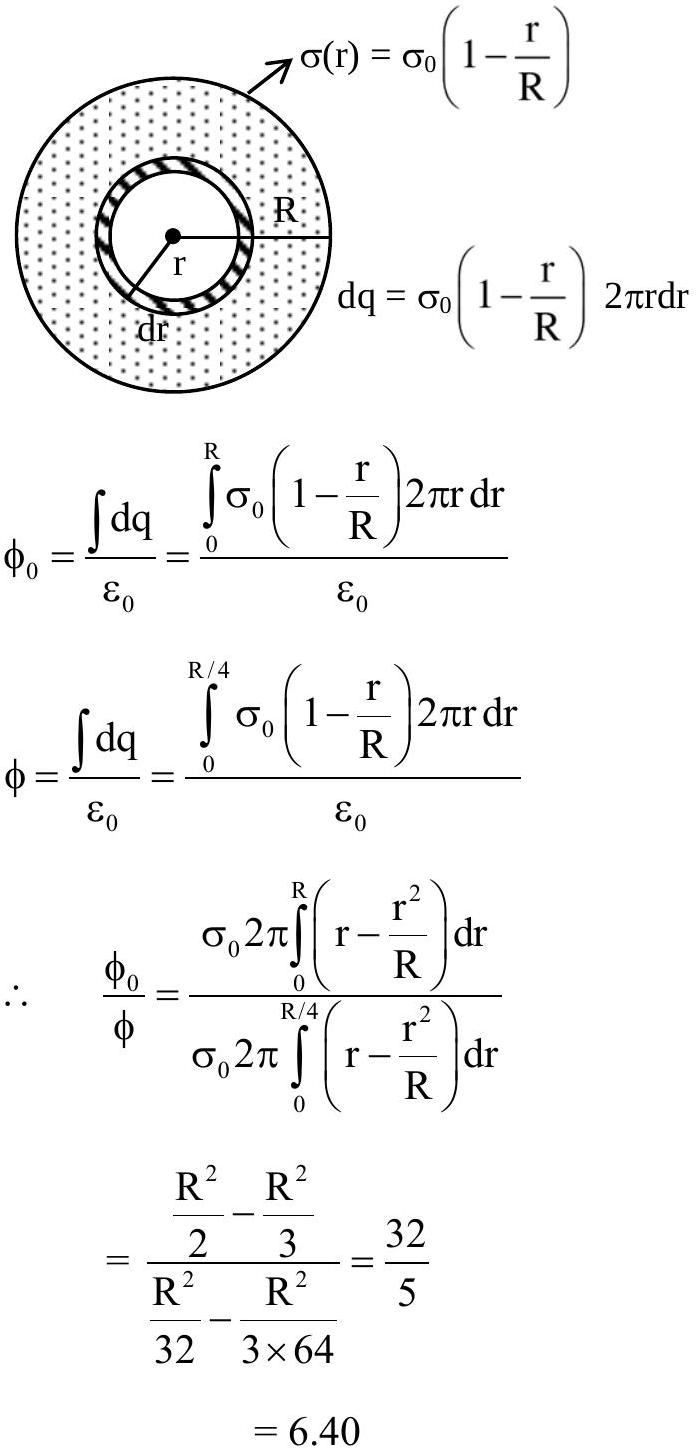
A circular disc of radius R carries surface charge density σ(r)=σ0(1−Rr), where σ0 is a constant and r is the distance from the center of the disc. Electric flux through a large spherical surface that encloses the charged disc completely is ϕ0. Electric flux through another spherical surface of radius 4R and concentric with the disc is ϕ. Then the ratio ϕϕ0 is ____.
Answer: 6.4
Solution
Total charge on disc: Q = ∫σ(r)·2πr dr from 0 to R = ∫σ₀(1-r/R)·2πr dr = 2πσ₀[r²/2 - r³/(3R)] from 0 to R = 2πσ₀[R²/2 - R²/3] = πσ₀R²/3. So φ₀ = Q/ε₀ = πσ₀R²/(3ε₀). For the smaller sphere of radius R/4, only charge within distance R/4 from center contributes: q = ∫₀^(R/4) σ₀(1-r/R)·2πr dr = 2πσ₀[r²/2 - r³/(3R)]₀^(R/4) = 2πσ₀[(R²/32) - (R²/192)] = 2πσ₀R²(5/192) = 5πσ₀R²/96. Thus φ = q/ε₀ = 5πσ₀R²/(96ε₀). Ratio: φ₀/φ = [πσ₀R²/(3ε₀)]/[5πσ₀R²/(96ε₀)] = 96/(3×5) = 32/5 = 6.40.