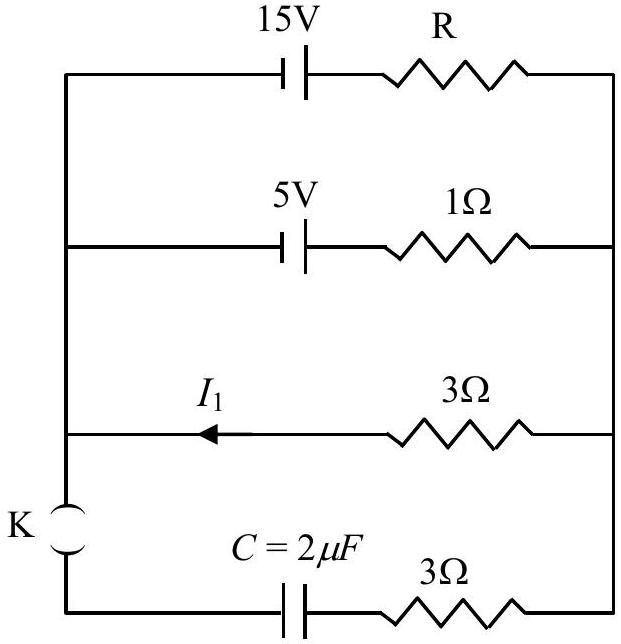
In a circuit shown in the figure, the capacitor C is initially uncharged and the key K is open. In this condition, a current of 1 A flows through the 1Ω resistor. The key is closed at time t=t0. Which of the following statement(s) is(are) correct? [Given: e−1=0.36]
(A)The value of the resistance R is 3Ω.✓ Correct
(B)For t<t0, the value of current I1 is 2A.✓ Correct
(C)At t=t0+7.2μs, the current in the capacitor is 0.6 A.✓ Correct
(D)For t→∞, the charge on the capacitor is 12μC.✓ Correct
Answer: (A), (B), (C), (D)
Solution
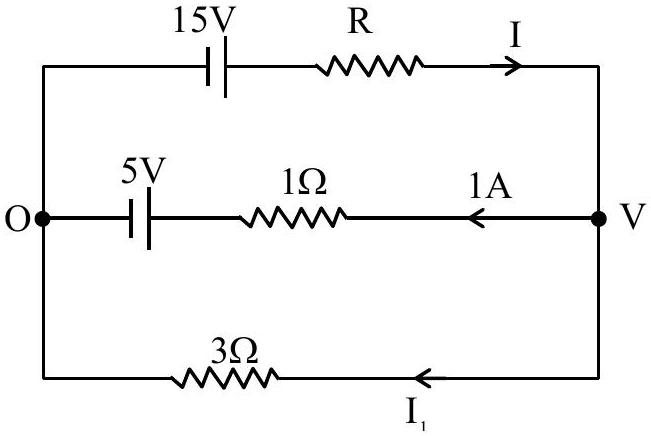
Before the key is closed (t<t0), the capacitor branch is open. Current through the 1Ω resistor is 1 A, so the voltage across it is 1 V. This means the node voltage is V=5+1=6 V.
For the branch with R: 15−IR=6, giving IR=9.
For the 3Ω branch: 6−3I1=0, giving I1=2 A. Option (B) is correct.
By KCL: I=1+2=3 A, so R=9/3=3Ω. Option (A) is correct.
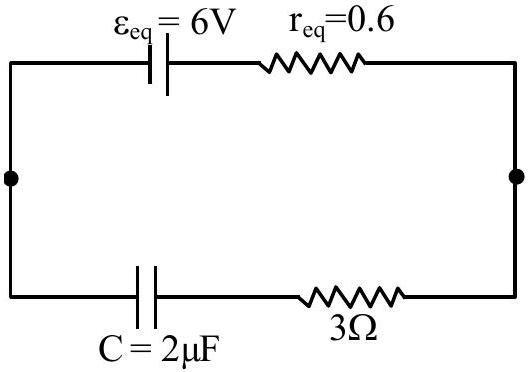
After the key closes, the Thevenin equivalent voltage is ε=6 V with equivalent resistance Req=3Ω∥1Ω∥3Ω=0.6Ω.
Time constant: τ=RC=3.6×2=7.2μs.
Current in capacitor: iC=3.66e−t/τ=35e−t/7.2.
At t=t0+7.2μs: iC=35e−1=35×0.36=0.6 A. Option (C) is correct.
For t→∞, the capacitor is fully charged to 6 V: Q=CV=2×6=12μC. Option (D) is correct.
JEE Advanced · 2023 · 04 Jun 2023 · Paper 1 · One or more correct options