JEE Advanced · 2024 · 26 May 2024 · Paper 2 · Units & Measurement

WhatsApp Email
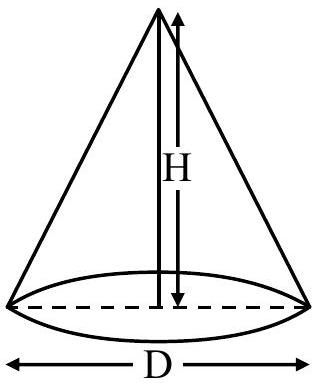
The dimensions of a cone are measured using a scale with a least count of 2 mm . The diameter of the base and the height are both measured to be 20.0 cm. The maximum percentage error in the determination of the volume is ____.

Answer: 3

Solution

The volume of a cone is .

The percentage error in volume is:


Given least count = 2 mm = 0.2 cm, and measurements D = H = 20.0 cm:


Therefore:

JEE Advanced · 2024 · 26 May 2024 · Paper 2 · Integer answer
More JEE Advanced questions on Units & Measurement

  1. Two thin wires, Wire-1 of diameter 0.650 mm and Wire-2 of unknown diameter are given. To obtain the value of , the diameters of the two wires are measured with a screw gauge. The screw gauge has a pitch of 0.5 mm and there are 100 divisions on the circular scale (CS). …
    JEE Advanced 2026View solution →
  2. In a new system of units, the units of mass, length, time and current are 5 kg, 5 m, 5 s and 5 A, respectively. If and are the permeability and permittivity of free space, respectively, then in this new system of units, the magnitude of one SI unit of …
    JEE Advanced 2026View solution →
  3. Figure 1 shows the configuration of main scale and Vernier scale before measurement. Fig. 2 shows the configuration corresponding to the measurement of diameter of a tube. The measured value of is:
    JEE Advanced 2025View solution →
  4. Length, breadth and thickness of a strip having a uniform cross section are measured to be 10.5 cm, 0.05 mm, and , respectively. Which of the following option(s) give(s) the volume of the strip in with correct significant figures:
    JEE Advanced 2025View solution →
  5. A single slit diffraction experiment is performed to determine the slit width using the equation, , where is the slit width, the shortest distance between the slit and the screen, the distance between the diffractio …
    JEE Advanced 2025View solution →
  6. A temperature difference can generate e.m.f. in some materials. Let be the e.m.f. produced per unit temperature difference between the ends of a wire, the electrical conductivity and the thermal conductivity of the material of the wire. Taking …
    JEE Advanced 2025View solution →