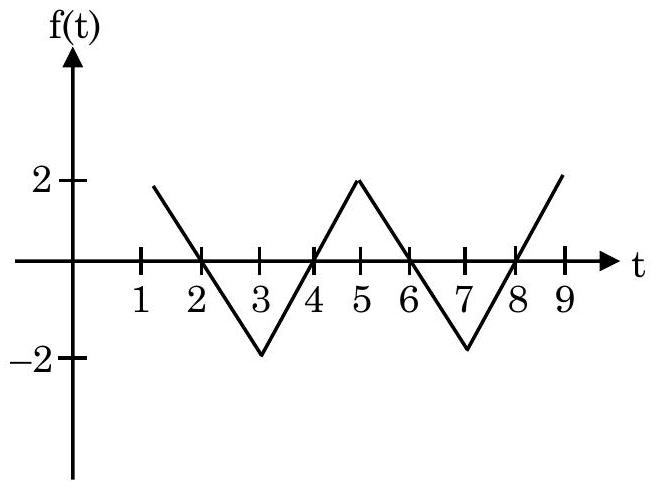
f(t)={(−1)n+12,2(2n+1−t)f(2n−1)+2(t−(2n−1))f(2n+1), if t=2n−1,n∈N, if 2n−1<t<2n+1,n∈N
Define g(x)=∫1xf(t)dt,x∈(1,∞). Let α denote the number of solutions of the equation g(x)=0 in the interval (1,8] and β=limx→1+x−1g(x). Then the value of α+β is equal to ____.
Answer: 5
Solution
The function f(t) is piecewise linear, alternating between +2 and −2 at odd integers, with linear interpolation between them.
At t=1,3,5,7,9,…, we have f(t)=2,−2,2,−2,… respectively.
Since g(x)=∫1xf(t)dt and g′(x)=f(x), the function g increases when f>0 and decreases when f<0.
The graph of f shows that f crosses zero at t=2,4,6,8,…
Since g(1)=0 and g alternates between increasing and decreasing, g(x)=0 at x=1,3,5,7 in the interval (1,8].