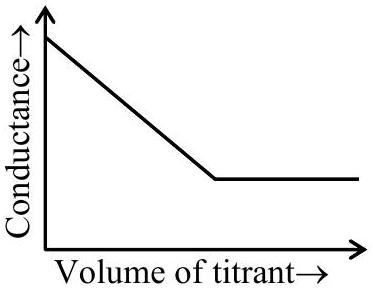
In a conductometric titration, small volume of titrant of higher concentration is added stepwise to a larger volume of titrate of much lower concentration, and the conductance is measured after each addition. The limiting ionic conductivity (Λ0) values (in mSm2mol−1) for different ions in aqueous solutions are given below:
Ions
Ag+
K+
Na+
H+
NO3−
Cl−
SO42−
OH−
CH3COO−
Λ0
6.2
7.4
5.0
35.0
7.2
7.6
16.0
19.9
4.1
For different combinations of titrates and titrants given in List-I, the graphs of 'conductance' versus 'volume of titrant' are given in List-II.
Match each entry in List-I with the appropriate entry in List-II and choose the correct option.
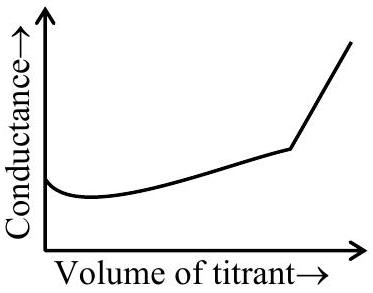
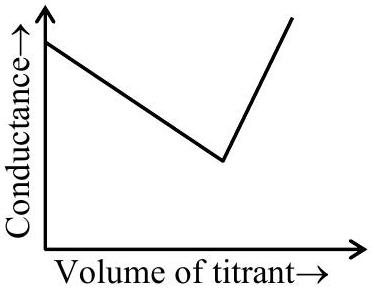
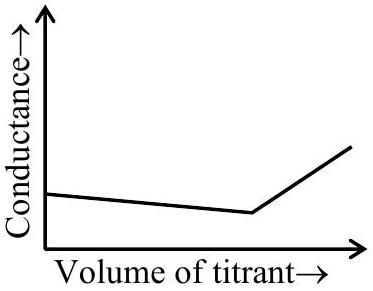
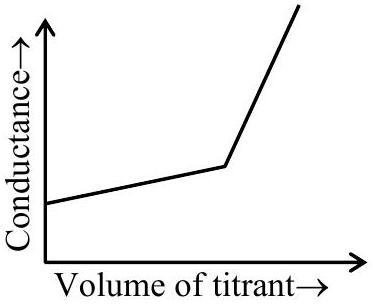
List-II (1) (see graph) (2) (see graph) (3) (see graph) (4) (see graph) (5) (see graph)12345
(A)P→4, Q→3, R→2, S→5
(B)P→2, Q→4, R→3, S→1
(C)P→3, Q→4, R→2, S→5✓ Correct
(D)P→4, Q→3, R→2, S→1
Answer: (C)
Solution
(P) Adding AgNO3 to KCl precipitates AgCl, replacing Cl− (7.6) with NO3− (7.2), so conductance decreases slightly until equivalence, then increases (graph 3). (Q) Adding KCl to AgNO3 precipitates AgCl, replacing Ag+ (6.2) with K+ (7.4), so conductance increases throughout (graph 4). (R) Adding HCl to NaOH replaces OH− (19.9) with Cl− (7.6), so conductance decreases until equivalence, then increases (graph 2). (S) Adding CH3COOH to NaOH replaces OH− (19.9) with CH3COO− (4.1), so conductance decreases; after equivalence, added weak acid remains largely undissociated, so conductance stays constant (graph 5).
JEE Advanced · 2024 · 26 May 2024 · Paper 1 · Single correct option