JEE Advanced · 2025 · 18 May 2025 · Paper 1 · Conservation of Momentum

WhatsApp Email
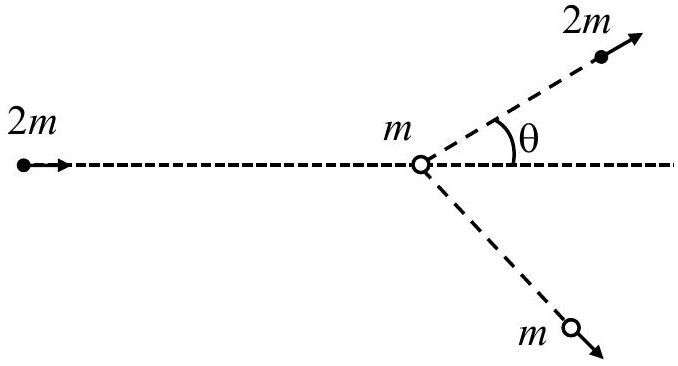
In a scattering experiment, a particle of mass collides with another particle of mass , which is initially at rest. Assuming the collision to be perfectly elastic, the maximum angular deviation of the heavier particle, as shown in the figure, in radians is:
  1. (A)
  2. (B)
  3. (C)
  4. (D)✓ Correct

Answer: (D)

Solution

For an elastic collision between particles of mass and , applying conservation of momentum and energy:

Momentum:

Energy:

Solving these equations leads to:


For real solutions, the discriminant must be non-negative:


The maximum deviation occurs when , giving .

JEE Advanced · 2025 · 18 May 2025 · Paper 1 · Single correct option
More JEE Advanced questions on Conservation of Momentum

  1. A uniform circular disk of radius 0.2 m and mass 1 kg is pivoted at its top point such that it can rotate freely around in the plane, as shown in the figure. Initially, when the disk is at rest, a particle of mass 20 g, travelling along negative direction …
    JEE Advanced 2026View solution →
  2. Two particles, 1 and 2, each of mass , are connected by a massless spring, and are on a horizontal frictionless plane, as shown in the figure. Initially, the two particles, with their center of mass at , are oscillating with amplitude and angular frequency . …
    JEE Advanced 2024View solution →
  3. Two particles, 1 and 2, each of mass , are connected by a massless spring, and are on a horizontal frictionless plane, as shown in the figure. Initially, the two particles, with their center of mass at , are oscillating with amplitude and angular frequency . …
    JEE Advanced 2024View solution →
  4. A heavy nucleus , at rest, undergoes fission , where and are two lighter nuclei. Let , where and are the masses of and , respectively. and are the kineti …
    JEE Advanced 2021View solution →
  5. A projectile is thrown from a point O on the ground at an angle 45° from the vertical and with a speed m/s. The projectile at the highest point of its trajectory splits into two equal parts. One part falls vertically down to the ground, 0.5 s after the splitting. The …
    JEE Advanced 2021View solution →
  6. A projectile is thrown from a point O on the ground at an angle 45° from the vertical and with a speed m/s. The projectile at the highest point of its trajectory splits into two equal parts. One part falls vertically down to the ground, 0.5 s after the splitting. The …
    JEE Advanced 2021View solution →