Let y=f(x) be the real valued function defined on the interval (0,∞), satisfying y(1)=0 and the differential equation
xdxdy=y−x3
Then which of the following statements is (are) TRUE ? (A) The function f has a local minimum at x=31 (B) The function f has a local maximum at x=31 (C) The function f is increasing in the interval (1,2) (D) If g(x)=4x3−5x2+23x for x>0, then the number of elements in the set {x∈(0,∞):f(x)=g(x)} is 2
(A)The function f has a local minimum at x=31
(B)The function f has a local maximum at x=31✓ Correct
(C)The function f is increasing in the interval (1,2)
(D)If g(x)=4x3−5x2+23x for x>0, then the number of elements in the set {x∈(0,∞):f(x)=g(x)} is 2✓ Correct
Answer: (B), (D)
Solution
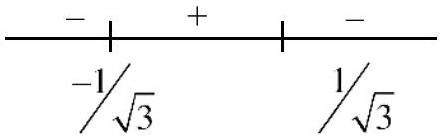
From xdy−ydx=−x3dx, we get d(xy)=−xdx, so xy=−2x2+c. Using y(1)=0: c=21. Thus y=2−x3+2x. Then dxdy=2−3x2+21=2−3(x−31)(x+31). For x>0: f increases on (0,31) and decreases on (31,∞), so local maximum at x=31 (option B). In (1,2), f is decreasing (option C false). For f(x)=g(x): 9x3−10x2+2x=0⇒x(9x2−10x+2)=0. Roots are x=0 and x=95±7 (both positive), giving 2 positive solutions (option D).
JEE Advanced · 2026 · 17 May 2026 · Paper 2 · One or more correct options