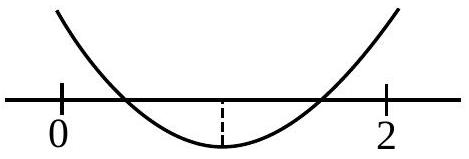
Let limx→2(x−2)2(tan(x−2))(r2+(p−2)x−2p)=5 for some r,p∈R. If the set of all possible values of q , such that the roots of the equation rx2−px+q=0 lie in ( 0,2 ), be the interval ( α,β ], then 4(α+β) equals.
(A)11
(B)13
(C)17✓ Correct
(D)21
Answer: (C)
Solution
For the limit to be finite, x−2tan(x−2)→1 forces x−2rx2+(p−2)x−2p to have a finite limit, so the numerator must vanish at x=2: 4r+2(p−2)−2p=4r−4=0, giving r=1. Then x2+(p−2)x−2p=(x−2)(x+p), and limx→2(x+p)=2+p=5, so p=3. The equation x2−3x+q=0 has both roots in (0,2) when the discriminant is non-negative, 9−4q≥0⇒q≤49; when f(0)=q>0; and when f(2)=q−2>0⇒q>2 (the vertex x=23 already lies in the interval). Hence q∈(2,49], so α=2,β=49 and 4(α+β)=4⋅417=17.
JEE Main · 2026 · 06 Apr 2026 · Shift 2 · Single correct option