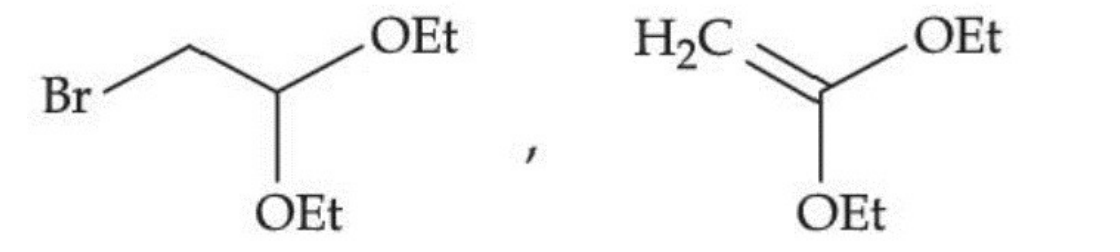
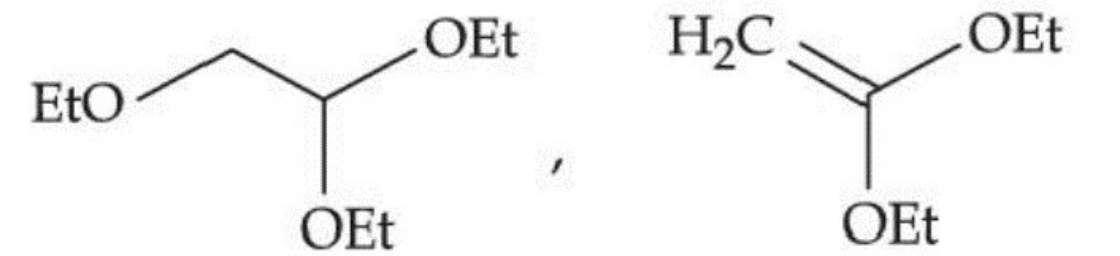
Br-C₆H₄-CHO reacts with EtOH (excess)/dry HCl gas to give major product 'A', which on treatment with t-BuO⁻K⁺ gives major product 'B'. Consider the above reaction sequence; products 'A' and 'B' formed respectively are: [structural options shown in source]
(A)[structure - refer to source PDF]✓ Correct
(B)[structure - refer to source PDF]
(C)[structure - refer to source PDF]
(D)[structure - refer to source PDF]
Answer: (A)
Solution
An aldehyde treated with excess ethanol and dry hydrogen chloride passes through the hemiacetal and ends as the diethyl acetal, the acid protonating the carbonyl oxygen and then the hemiacetal hydroxyl so that the second alcohol can add and water can leave. A is therefore BrCH2CH(OC2H5)2, in which the carbonyl group is protected but the C–Br bond is untouched. Potassium tert-butoxide is a strong base but too bulky to reach the carbon carrying bromine, so substitution is suppressed and it removes instead the proton on the neighbouring acetal carbon; bromide leaves and a double bond closes between the two carbons. B is thus the ketene acetal CH2=C(OC2H5)2. A and B are 1-bromo-2,2-diethoxyethane and 1,1-diethoxyethene.
JEE Main · 2021 · 25 Jul 2021 · Shift 2 · Single correct option