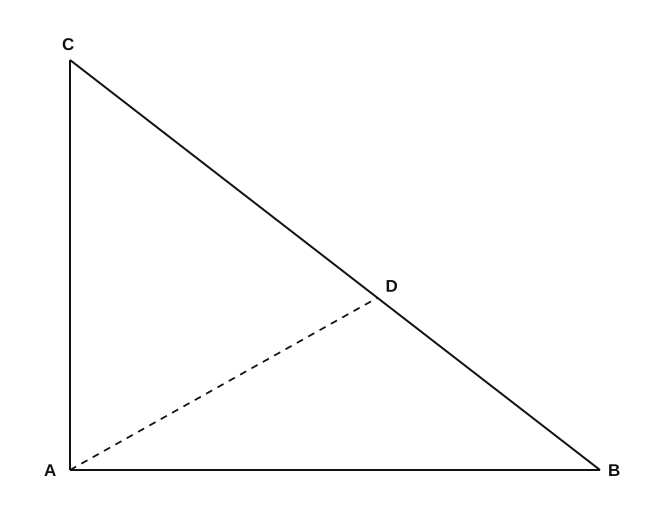
ABC is a triangle, right angled at A. The resultant of the forces acting along AB, AC with magnitudes AB1 and AC1 respectively is the force along AD, where D is the foot of the perpendicular from A onto BC. The magnitude of the resultant is
(A)(AB)2(AC)2AB2+AC2
(B)AB+AC(AB)(AC)
(C)AB1+AC1
(D)AD1✓ Correct
Answer: (D)
Solution
Place the right angle at A so that the two forces, of magnitudes AB1 and AC1, act along the mutually perpendicular directions AB and AC. Being perpendicular, their resultant has magnitude (AB1)2+(AC1)2=AB⋅ACAB2+AC2. Now AB2+AC2=BC by Pythagoras, and comparing the two expressions for the area of the triangle, 21AB⋅AC=21BC⋅AD, gives AB⋅AC=BC⋅AD. Substituting, the magnitude becomes AB⋅ACBC=BC⋅ADBC=AD1, which is exactly the size of the resultant directed along AD.
JEE Main · 2006 · 30 Apr 2006 · Offline · Single correct option