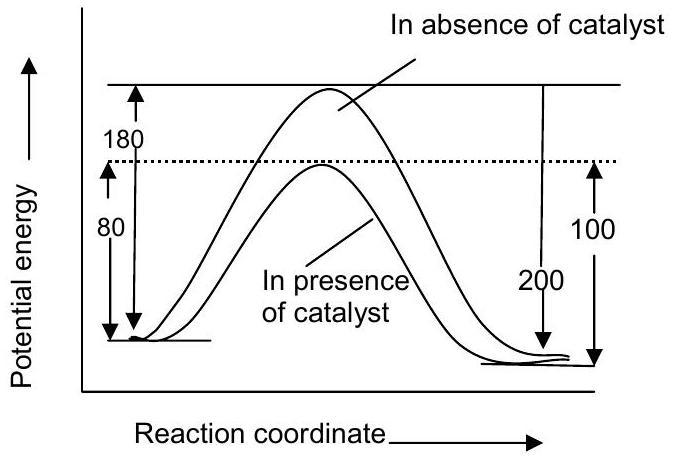
The energies of activation for forward and reverse reactions for A2+B2⇌2AB are 180kJmol−1 and 200kJmol−1 respectively. The presence of catalyst lowers the activation energy of both (forward and reverse) reactions by 100kJmol−1. The enthalpy change of the reaction (A2+B2⟶2AB) in the presence of catalyst will be (in kJmol−1)
(A)300
(B)120
(C)280
(D)20✓ Correct
Answer: (D)
Solution
The enthalpy change of a reaction is the difference between the forward and reverse activation energies, and it is fixed by the initial and final states rather than by the path or a catalyst. Without a catalyst it is 180−200=−20 kJ per mole. A catalyst lowers both barriers by the same 100 kJ, giving 80 and 100 kJ, whose difference is again −20 kJ per mole; in magnitude the enthalpy change stays 20 kJ per mole.
JEE Main · 2007 · 29 Apr 2007 · Offline · Single correct option