JEE Main · 2008 · 27 Apr 2008 · Offline · Modern Physics

WhatsApp Email
Passage
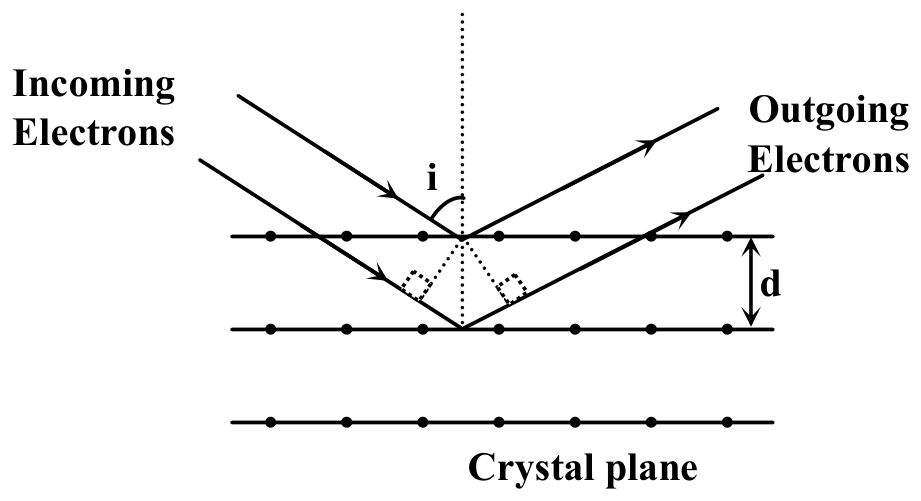
Wave property of electrons implies that they will show diffraction effects. Davisson and Germer demonstrated this by diffracting electrons from crystals. The law governing the diffraction from a crystal is obtained by requiring that electron waves reflected from the planes of atoms in a crystal interfere constructively (see in figure).
If a strong diffraction peak is observed when electrons are incident at an angle 'i' from the normal to the crystal planes with distance 'd' between them (see figure), de Broglie wavelength of electrons can be calculated by the relationship (n is an integer)
  1. (A)
  2. (B)✓ Correct
  3. (C)
  4. (D)

Answer: (B)

Solution

The electron waves reflected from successive atomic planes interfere constructively when their path difference is a whole number of wavelengths. Here the angle is measured from the normal to the planes, so the extra path travelled between reflections from two planes a distance apart is . Setting this equal to an integer number of de Broglie wavelengths gives the diffraction condition . This item carries a figure that was not captured with the question; the relation above follows from the stated geometry alone, but the missing diagram should be restored before the question is used.

JEE Main · 2008 · 27 Apr 2008 · Offline · Single correct option
More JEE Main questions on Modern Physics

  1. 7.9 MeV α-particle scatters from a target material of atomic number 79. From the given data the estimated diameter of nuclei of the target material is (approximately) ______ m.
    [ Nm²/C² and electron charge C]
    JEE Main 2026View solution →
  2. The minimum frequency of photon required to break a particle of mass 15.348 amu into particles is ______ kHz.
    [mass of He nucleus = 4.002 amu, amu kg, J.s and m/s]
    JEE Main 2026View solution →
  3. The smallest wavelength of Lyman series is 91 nm. The difference between the largest wavelengths of Paschen and Balmer series is nearly nm.
    JEE Main 2026View solution →
  4. Light is incident on a metallic plate having work function . If the produced photoelectrons have zero kinetic energy then the angular frequency of the incident light is ______ . ( …
    JEE Main 2026View solution →
  5. The energy of an electron in an orbit of the Bohr's atom is where is the ground state energy. If L is the angular momentum of the electron in this orbit and h is the Planck's constant, then …
    JEE Main 2026View solution →
  6. A particle having electric charge and mass is accelerated by applying an electric potential of 1.21 V . Wavelength of the matter wave associated with the particle is . The va …
    JEE Main 2026View solution →