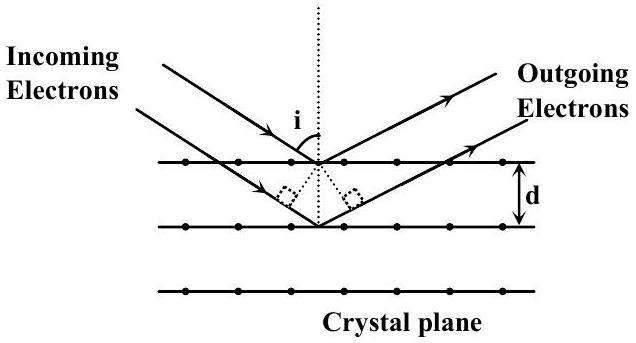
Wave property of electrons implies that they will show diffraction effects. Davisson and Germer demonstrated this by diffracting electrons from crystals. The law governing the diffraction from a crystal is obtained by requiring that electron waves reflected from the planes of atoms in a crystal interfere constructively (see in figure).
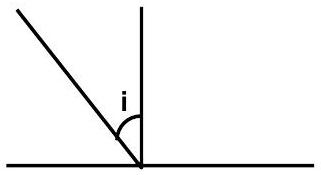
Electrons accelerated by potential V are diffracted from a crystal. If d=1A˚ and i=30∘,V should be about (h=6.6×10⁻³⁴Js,me=9.1×10⁻³¹kg,e=1.6×10⁻¹⁹C)
(A)2000 V
(B)50 V✓ Correct
(C)500 V
(D)1000 V
Answer: (B)
Solution
The diffraction condition for the angle measured from the normal is 2dcosi=nλ, and the de Broglie wavelength after acceleration through a potential V is λ=2meVh. Taking the first order and combining, 2dcosi=2meVh, which solves to V=8med2cos2ih2. Substituting d=10−10m, i=30∘ so that cos2i=43, together with the given constants, the accelerating voltage comes out to about 50V.
JEE Main · 2008 · 27 Apr 2008 · Offline · Single correct option