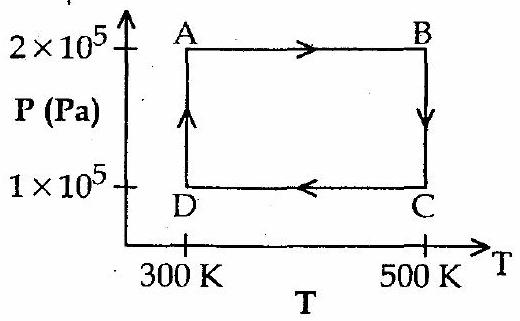
Two moles of helium gas are taken over the cycle ABCDA, as shown in the P–T diagram. [Figure — cycle ABCDA in the P–T plane: A and B lie on the isobar at 2×10⁵ Pa; D and C lie on the isobar at 1×10⁵ Pa; A and D are at 300 K, B and C are at 500 K. A→B is isobaric (2×10⁵ Pa, 300 K→500 K), B→C is isothermal (500 K), C→D is isobaric (1×10⁵ Pa, 500 K→300 K), D→A is isothermal (300 K). n=2,γ=1.67.]
The work done on the gas in taking it from D to A is
(A)– 414 R✓ Correct
(B)+ 414 R
(C)– 690 R
(D)+ 690 R
Answer: (A)
Solution
The step from D to A happens at the constant temperature 300 K, so it is an isothermal process and the work can be read from W=nRTlnPfPi. Here the pressure rises from 1×10⁵ Pa at D to 2×10⁵ Pa at A, so with n=2 and T=300 K the work is 2R×300×2.303log2×1051×105=600R×(−0.693), which comes to −414R.
JEE Main · 2009 · 12 Apr 2009 · Offline · Single correct option