JEE Main · 2009 · 12 Apr 2009 · Offline · Geometrical Optics

WhatsApp Email
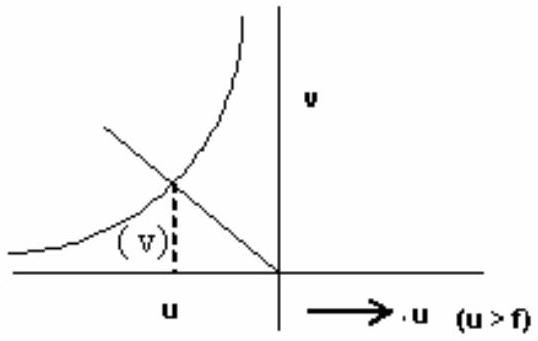
In an optics experiment, with the position of the object fixed, a student varies the position of a convex lens and for each position, the screen is adjusted to get a clear image of the object. A graph between the object distance and the image distance , from the lens, is plotted using the same scale for the two axes. A straight line passing through the origin and making an angle of with the x-axis meets the experimental curve at P . The coordinates of P will be
  1. (A)✓ Correct
  2. (B)
  3. (C)(f, f)
  4. (D)(4f, 4f)

Answer: (A)

Solution

The line through the origin is the locus , so the point P marks the lens position where the image distance equals the object distance. For a convex lens this equality happens only when the object is at twice the focal length, and then the image also forms at twice the focal length, as the lens equation confirms with . The coordinates of P are therefore .

JEE Main · 2009 · 12 Apr 2009 · Offline · Single correct option
More JEE Main questions on Geometrical Optics

  1. Consider an equilateral prism (refractive index ). A ray of light is incident on its one surface at a certain angle . If the emergent ray is found to graze along the other surface then the angle of refraction at the incident surface is close to ____ .
    JEE Main 2026View solution →
  2. A parallel beam of light travelling in air (refractive index 1.0) is incident on a convex spherical glass surface of radius of curvature 50 cm . Refractive index of glass is 1.5 . The rays converge to a point at a distance x cm from the centre of the curvature of the spherical su …
    JEE Main 2026View solution →
  3. In parallax method for the determination of focal length of a concave mirror, the object should always be placed :
    JEE Main 2026View solution →
  4. The wavelength of light, while it is passing through water is 540 nm. The refractive index of water is . The wavelength of the same light when it is passing through a transparent medium having refractive index of is nm.
    JEE Main 2026View solution →
  5. As shown in the diagram, when the incident ray is parallel to base of the prism, the emergent ray grazes along the second surface.

    If refractive index of the material of prism is , the angle of prism is.
    JEE Main 2026View solution →
  6. A thin prism with angle of refractive index 1.72 is combined with another prism of refractive index 1.9 to produce dispersion without deviation. The angle of second prism is ______.
    JEE Main 2026View solution →