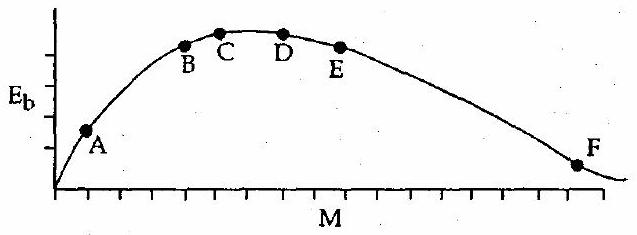
The above is a plot of binding energy per nucleon Eb, against the nuclear mass M;A,B,C,D,E,F correspond to different nuclei. Consider four reactions: (i) A+B→C+ε (ii) C→A+B+ε (iii) D+E→F+ε and (iv) F→D+E+ε where ε is the energy released? In which reactions is ε positive?
(A)(i) and (iv)✓ Correct
(B)(i) and (iii)
(C)(ii) and (iv)
(D)(ii) and (iii)
Answer: (A)
Solution
Energy is released only when the products sit higher on the binding-energy-per-nucleon curve than the reactants, because greater binding energy per nucleon means a more tightly bound, lower-energy state. Light nuclei A and B fusing into C climb the rising part of the curve and so release energy, and the heavy nucleus F splitting into D and E moves up the falling part of the curve and likewise releases energy. These are the first and fourth reactions.
JEE Main · 2009 · 12 Apr 2009 · Offline · Single correct option