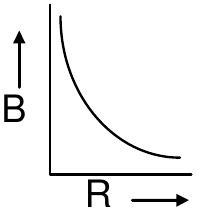
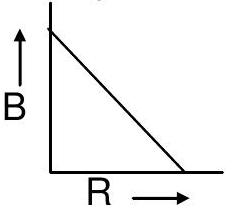
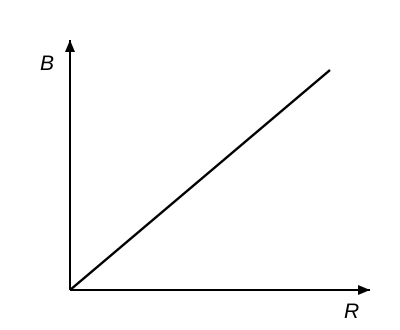
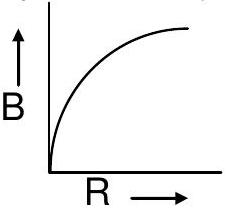
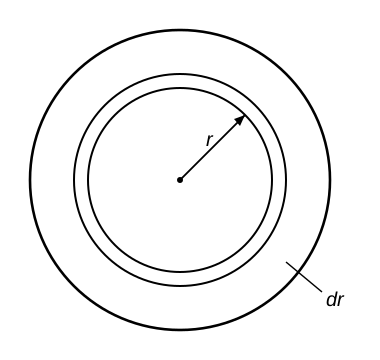
A charge Q is uniformly distributed over the surface of non conducting disc of radius R. The disc rotates about an axis perpendicular to its plane and passing through its centre with an angular velocity ω. As a result of this rotation a magnetic field of induction B is obtained at the centre of the disc. If we keep both the amount of charge placed on the disc and its angular velocity to be constant and vary the radius of the disc then the variation of the magnetic induction at the centre of the disc will be represented by the figure
(A)(see structure)✓ Correct
(B)(see structure)
(C)(see structure)
(D)(see structure)
Answer: (A)
Solution
Model the spinning charged disc as nested rings. A ring of radius x and width dx holds charge dq=σ2πxdx with σ=πR2Q, and turning at angular speed ω it carries a current di=2πdqω=σωxdx. Its field at the centre is dB=2xμ0di=2μ0σωdx, and integrating from 0 to R gives B=2μ0σωR=2πRμ0Qω. With the charge and the angular speed held fixed, B∝R1, so the graph is a rectangular hyperbola that falls as the radius grows.
JEE Main · 2012 · 29 Apr 2012 · Offline · Single correct option