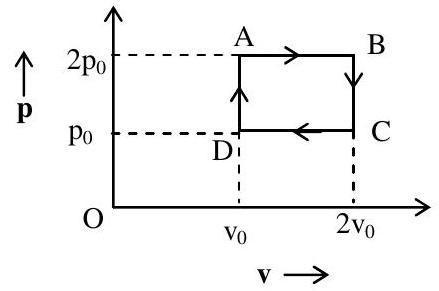
The above p-v diagram represents the thermodynamic cycle of an engine, operating with an ideal monoatomic gas. The amount of heat extracted from the source in a single cycle is
(A)(213)p0v0✓ Correct
(B)(211)p0v0
(C)4p0v0
(D)p0v0
Answer: (A)
Solution
Read the cycle off the p-V rectangle: the gas runs D(v0,p0)→A(v0,2p0)→B(2v0,2p0)→C(2v0,p0)→D. Heat is drawn from the source only on the legs where the temperature rises. On D→A the volume is held at v0 while the pressure rises p0→2p0, so QDA=nCVΔT=23VΔp=23p0v0. On A→B the pressure is held at 2p0 while the volume rises v0→2v0, so QAB=nCPΔT=25pΔV=25(2p0)(v0)=5p0v0. The return legs B→C and C→D are cooling and compression, on which heat is rejected, not absorbed. The heat extracted from the source in one cycle is therefore 23p0v0+5p0v0=213p0v0, using CV=23R and CP=25R for a monoatomic gas.
JEE Main · 2013 · 07 Apr 2013 · Offline · Single correct option