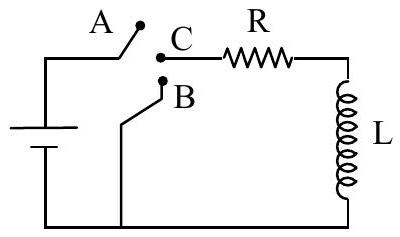
In the circuit shown here, the point 'C' is kept connected to point 'A' till the current flowing through the circuit becomes constant. Afterward, suddenly, point 'C' is disconnected from point 'A' and connected to point 'B' at time t=0. Ratio of the voltage across resistance and the inductor at t=L/R will be equal to:
(A)-1✓ Correct
(B)e1−e
(C)1−ee
(D)1
Answer: (A)
Solution
While C rests on A the current climbs to its steady value i0=Rε, at which point the inductor is fully energised and dtdi=0. When C is thrown over to B at t=0 the cell is cut out and the resistor and inductor are left alone in a single series loop, so the current now decays as i=i0e−Rt/L. Kirchhoff's voltage law around that source-free loop reads iR+Ldtdi=0, which says the drop across the resistor and the drop across the inductor are equal in size but opposite in sign at every instant: VR=iR=i0Re−Rt/L while VL=Ldtdi=−i0Re−Rt/L. Their ratio is VLVR=−1, independent of time and so equal to −1 at t=L/R as well. The two elements sit in series in this decay loop, not in parallel, which is exactly why the signed ratio is −1 and not +1.
JEE Main · 2014 · 06 Apr 2014 · Offline · Single correct option