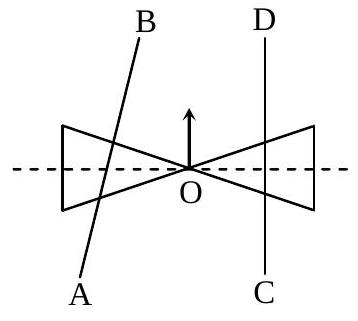
A roller is made by joining together two cones at their vertices O. It is kept on two rails AB and CD which are placed asymmetrically (see figure), with its axis perpendicular to CD and its centre O at the centre of line joining AB and CD (see figure). It is given a light push so that it starts rolling with its centre O moving parallel to CD in the direction shown. As it moves, the roller will tend to:
(A)turn right
(B)go straight
(C)turn left and right alternately
(D)turn left✓ Correct
Answer: (D)
Solution
The double cone rests across two rails that are not symmetric, so its two circles of contact have different radii. Rolling without slipping ties the distance each contact point travels to its radius, so the side on the larger radius advances faster per turn than the side on the smaller radius. That mismatch swings the axis, steering the roller toward the smaller-radius side, which here is to the left. So it tends to turn left.
JEE Main · 2016 · 03 Apr 2016 · Offline · Single correct option