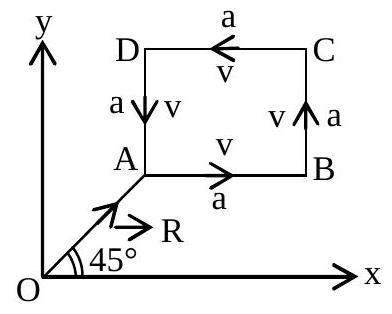
A particle of mass m is moving along the side of a square of side 'a', with a uniform speed v in the x−y plane as shown in the figure :
Which of the following statements is false for the angular momentum L about the origin?
(A)L=mv[2R−a]k^ when the particle is moving from C to D.✓ Correct
(B)L=mv[2R+a]k^ when the particle is moving from B to C.
(C)L=2mVRk^ when the particle is moving from D to A.
(D)L=−2mvRk^ when the particle is moving from A to B.
Answer: (A)
Solution
Angular momentum about the origin is L=mr×v, and on each straight leg its magnitude is mv times the perpendicular distance from the origin to that line of motion, with the sign set by the sense of rotation. Working leg by leg with the geometry of the square, the segment from C to D gives L=mv[2R+a]k^. The statement that assigns this leg the value mv[2R−a]k^ disagrees with the correct perpendicular distance, so it is the false one.
JEE Main · 2016 · 03 Apr 2016 · Offline · Single correct option