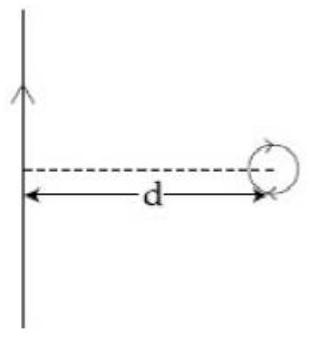
An infinitely long current carrying wire and a small current carrying loop are in the plane of the paper as shown. the radius of the loop is a and distance of its centre from the wire is d(d≫a). If the loop applies a force F on the wire then:
(A)F=0
(B)F∝(da)
(C)F∝(d3a2)
(D)F∝(da)2✓ Correct
Answer: (D)
Solution
Treat the small loop as a magnetic dipole of moment M=Iπa2 sitting in the wire's non-uniform field B∝d1. The force on a dipole comes from the field gradient, F=MdddB, and since dddB∝d21 we get F∝a2⋅d21=(da)2. By Newton's third law the loop pushes on the wire exactly as hard as the wire pushes on the loop, so the force on the wire carries the same (da)2 dependence.
JEE Main · 2019 · 09 Jan 2019 · Shift 1 · Single correct option