JEE Main · 2019 · 09 Jan 2019 · Shift 2 · Quadratic Equations and Inequalities

WhatsApp Email
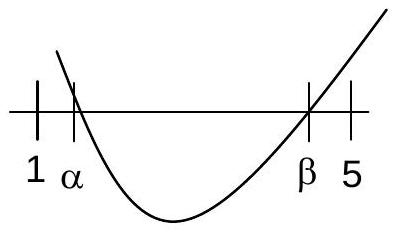
If both the roots of the quadratic equation are real and distinct and they lie in the interval , then lies in the interval.
  1. (A)✓ Correct
  2. (B)
  3. (C)
  4. (D)

Answer: (A)

Solution

For both roots of to be real and distinct the discriminant must be positive, ; since the product of the roots is and they are to lie in the sum is positive, so . The parabola opens upward, so it must be non-negative at the ends of the interval: gives and gives . The vertex abscissa already lies in . Combining these conditions, lies in .

JEE Main · 2019 · 09 Jan 2019 · Shift 2 · Single correct option
More JEE Main questions on Quadratic Equations and Inequalities

  1. The sum of all the roots of the equation , is:
    JEE Main 2026View solution →
  2. Let and be the roots of equation such that . Then the set of all possible values of is :
    JEE Main 2026View solution →
  3. Let be the roots of the quadratic equation . If , then the sum of all possible values of is :
    JEE Main 2026View solution →
  4. If and () are the roots of the equation , , then is equal to :
    JEE Main 2026View solution →
  5. A building construction work can be completed by two masons A and B together in 22.5 days. Mason A alone can complete the construction work in 24 days less than mason B alone. Then mason A alone will complete the construction work in:
    JEE Main 2026View solution →
  6. The smallest positive integral value of , for which all the roots of are real and distinct, is equal to
    JEE Main 2026View solution →